
Between Washington and Tehran: Pakistan’s Diplomatic Moment and India’s Questioned Role
Sharaf Anjum Prova | 09 May 2026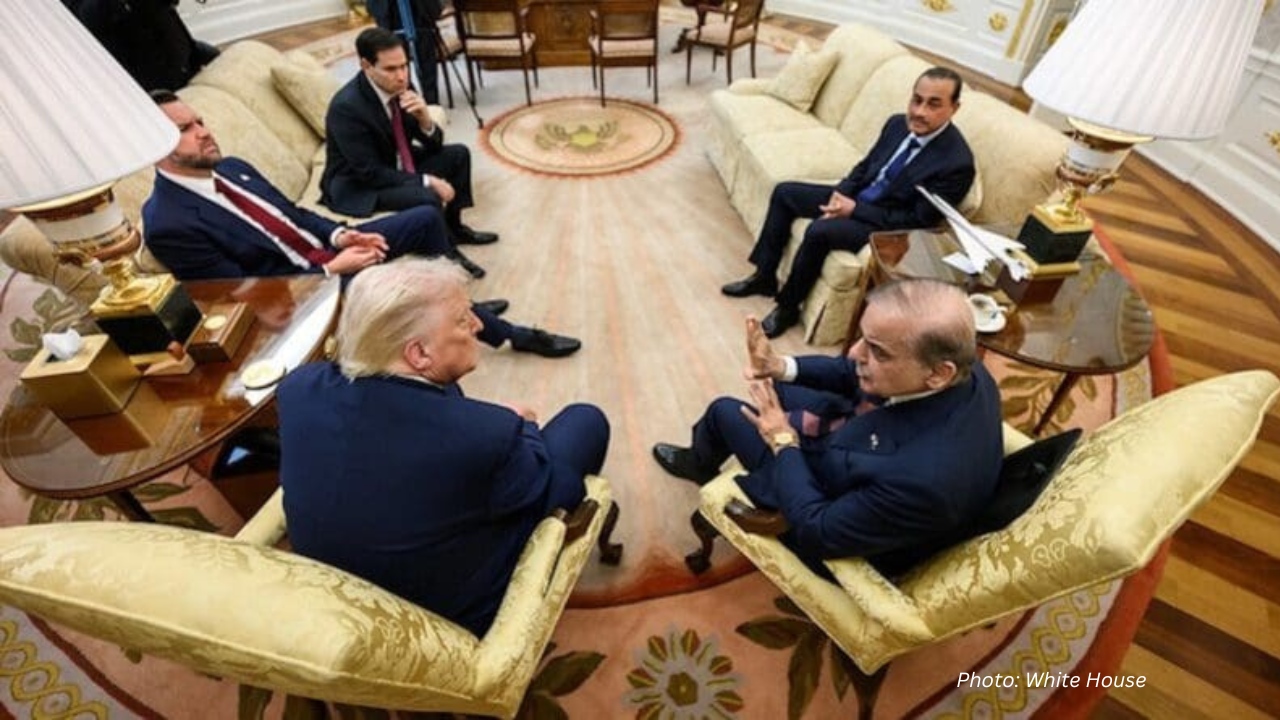
In this contemporary world, a country’s influence and relevance extend beyond traditional metrics such as military capability and economy size. Among significant factors that contribute to strategic value of a state, diplomatic prowess and capacity to mediate during hostilities have become more pertinent in recent times. Although this strategic value may not last for decades, it may prove to be advantageous in the short run for a country like Pakistan as it plays the part of an intermediary actor to facilitate diplomatic channels between USA and Iran. Concurrently, this mediation brings India to the conversation as the country’s role or lack of it raises questions about the consistency of India’s regional authority.
Pakistan is pushing for a ‘Peace Deal’ to ease the standoff- eventually putting all the hostilities to an end. However, between the US president and Iranian authority, the circumstances may intensify at any moment. The combination of rhetoric, military posturing, and negotiation hints at the unstable nature of the current moment, where escalation and dialogue co-exist.
For Pakistan, the concerns are far more perilous than the regional war that would affect the domestic energy sector and oil supply. There’s a high possibility of Pakistan being dragged into the war because of its security partnership with Saudi Arabia. With everything going on at home, including militant activities, cross-border hostilities with Talibans, possible International Humanitarian Law (IHL) violations and reports highlighting usage of excessive force in Balochistan by security forces, Pakistan is unwilling to become a part of a regional military escalation.
However, among all the political chaos, Pakistan has continued to play an active role in international diplomacy. This implies a degree of compartmentalization in Pakistan’s approach, as domestic instability and border tensions have not fully constrained the external diplomatic engagements. The result is Pakistan pushing through a surge of diplomacy to bring Washington and Tehran to the negotiation table and put an end to the brewing war. These evolving dynamics between USA and Pakistan also indicate that the new Pakistani regime has transformed previously strained ties into a functional diplomatic relationship, reflected in Trump’s decision to rely on Pakistan as a mediator. This mediatory role is not unprecedented as historically Pakistan has played similar role at critical moments, most notably, during the US-China rapprochement in 1971. The USA made a strategic calculation then and is doing the same now.
Reactions to this intermediary role have been mixed. Some analysts have described it as ironic as China is facilitating negotiation between Pakistan and Afghanistan, making Islamabad both a mediator and a party to mediation. Others interpret Pakistan’s actions as pragmatic and tactical because of the risks of direct involvement in a multi-state confrontation.
States and leaders act according to cost-benefit calculations, which is the core idea of Rational Choice Theory. The theory suggests that a state would choose the option that ensures maximum strategic gain with lowest possible cost. Within this particular context, Pakistan’s diplomatic outreach and mediatory efforts make a solid case in support of the theory and vice versa. By positioning itself as a mediator, Pakistan stands to gain diplomatic visibility and global relevance with little to no political or economic cost. Its geopolitical location, nuclear capability and simultaneous diplomatic relationship with Beijing, Washington and the Gulf States provide additional leverage. Islamabad is effectively navigating the situation as it seeks to attract business and investment through the Special Investment Facilitation Council (SIFC) and policy reforms.
The White House has begun to regard Islamabad as a bridge connecting South Asia, Middle East and developed democracies. Pakistan sharing a border, Tehran’s trust and its ambition to emerge as an investment hub makes it a suitable mediator. Recent export of Pakistan’s rare earth material to USA and discussions for further business and investment on crypto, mining and some other sectors indicate Trump Administration’s gesture to welcome Pakistan back to diplomatic normalcy.
Decision making in Washington has become highly personalized, often shaped by the President’s instincts and personal preferences. Pakistan’s leadership has adapted to this setting and has been using it to strengthen its position in USA, drawing on several recent developments- Islamabad’s performance during last year’s conflict with India, a more active role in Middle Eastern politics, participation in Trump’s ‘Board of Peace’ initiative and the defense agreement with Saudi Arabia. All these have enhanced Pakistan’s relevance in US policy circles while also subtly shifting the balance of attention in South Asia, creating a contrast with India. New Delhi’s traditionally strong position in Washington has faltered due to USA’s high tariffs, new H-1B visa restrictions and anger over India purchasing Russian oil. As a result, Washington is turning to Islamabad instead.
This shift in regional dynamics has also shaped how India’s foreign policy is being assessed. Critics have placed New Delhi under scrutiny for its lack of involvement in resolving USA-Iran conflict. Some Indian analysts and politicians have described India’s inaction as a missed opportunity to show its presence in the region, whereas Indian National Congress went to the extent of calling Indian diplomacy an embarrassment and the contrast with Pakistan has further sharpened the criticism as the two countries have a long-standing historical rivalry.
Over the years, India’s foreign policy appears to be tilted towards USA and Israel, reflecting a shift from its traditional emphasis on strategic balance. Narendra Modi’s close engagements with Benjamin Netanyahu combined with a relatively muted response to key developments during the hostilities are the crucial contributing factors of the critical perspective aimed at the government of India. Another factor fueling such comparisons is India’s strained diplomatic relationship with several of its neighbors and then there’s the tariff issue.
As Pakistan tries to uphold itself as a responsible global actor, in contrast, India appears to lag behind in the ‘war of narratives’, having been diplomatically outmaneuvered by Pakistan on several occasions. Taking everything into account, it can be said that a shifting landscape of influence is taking place in South Asia amid the hostilities in Middle East. These intersecting dynamics suggest that states actively engaging in diplomatic mediation can, even temporarily, elevate their status and reshape narratives about their role in the international system.
Pakistan’s ultimate goal from this mediatory role is to achieve global attention and at the same time, keep the intensity of hostilities in check to avoid direct military involvement. As long as Islamabad hosts without any incident, it appears to gain simply from providing backdoor diplomatic channels where both sides can arrive at a settlement they perceive as an honorable exit. The added regional attention or comparison to India is more of a by-product than a primary goal.
• Sharaf Anjum Prova, Research Intern, Centre for Governance Studies (CSG)