
Women’s Leadership, Gender Equality and Political Commitments.
14 January 2026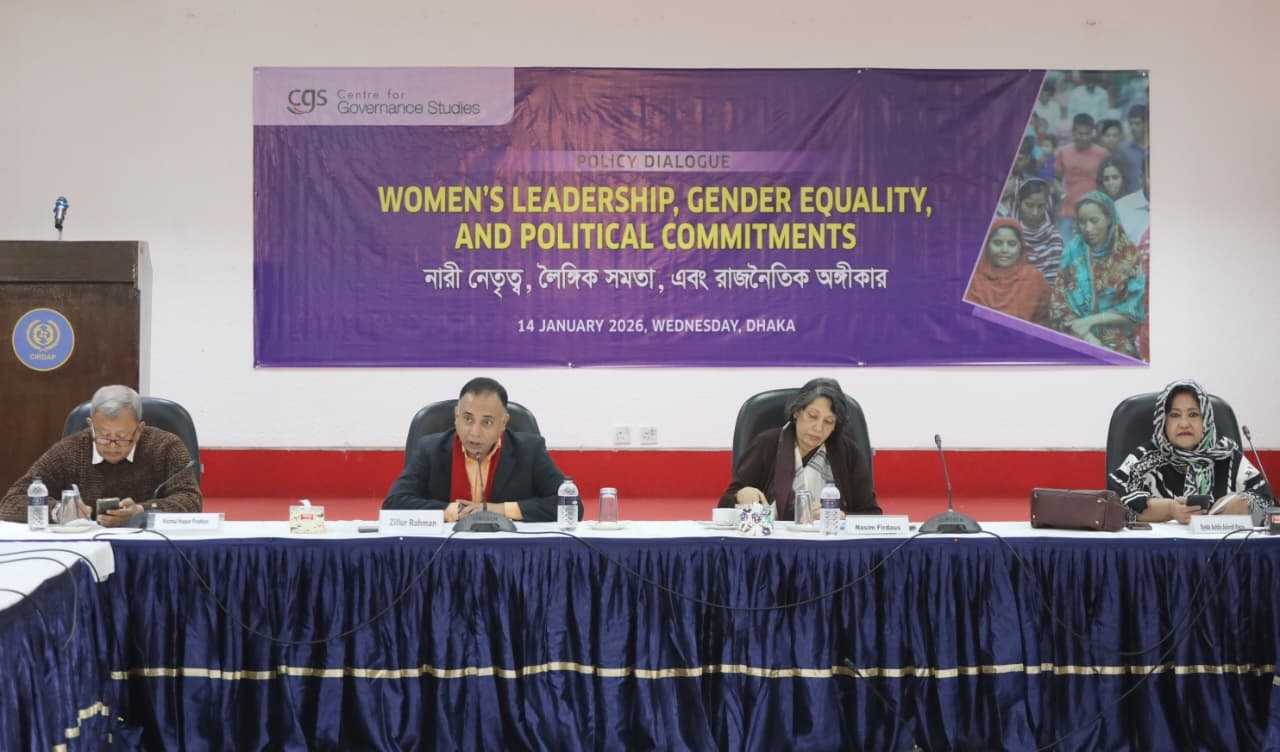
|

Press Release
14 January 2026
Political Will is Essential for Increasing Women's Leadership
Nearly 70% of Women Do Not Feel Safe
Women Are Currently Facing the Worst Time in Bangladesh's History
-Speakers at the Policy Dialogue organized by CGS
The Centre for Governance Studies (CGS) organized a policy dialogue titled “Women’s Leadership, Gender Equality and Political Commitments.” The discussion was held on Wednesday, January 14, 2026, at the CIRDAP (Centre on Integrated Rural Development for Asia and the Pacific) Auditorium in Dhaka. Political leaders, civil society representatives, academics, lawyers, and human rights activists participated in the discussion. The policy dialogue focused on how women's leadership and gender equality can be ensured through clear commitments and policy reforms by political parties ahead of the upcoming election.
Among the speakers at the event were Nasim Ferdous, Founder and President of the Bangladesh Women Leadership Alliance, Politician and Former Member of Parliament Syeda Asifa Ashrafi Papiya, General Secretary of the National Socialist Party Nazmul Hossain, Central Organizing Secretary of Bangladesh Nationalist Party (BNP) Shama Obyed, Chairperson of Universal Medical College and Hospital Limited Priti Chakraborty, President of Bangladesh Women Entrepreneurs Association Nasrin Fatema Awal, Professor of Women and Gender Studies at Dhaka University Dr. Syed Md. Shaikh Imtiaz, Trans Feminist and Rights Activist Ho Chi Minh Islam, President of the State Reform Student Movement Lamiya Islam, Senior Vice President of Gano Adhikar Parishad Faruk Hasan, Corporate Sales Manager of Robi Axiata and Founder of Tagra BD Tahreem Khan Zahid, Organizational Secretary of Khelafat Majlis Kazi Minhazul Alam, Advocate Elina Khan, and CGS President Zillur Rahman, among others.
At the beginning of the event, Zillur Rahman, President of CGS, stated that although there are more women than men in Bangladesh, we see very little female leadership. Political parties' attitudes towards nominating women are quite narrow. Many commitments have been made in SDG (Sustainable Development Goals) targets regarding women, but the reality is different. Women often do not perform their responsibilities in Bangladesh's development, as many mothers do not want their daughters to go into leadership. Women’s leadership, gender equality, and political commitment are three very important issues. Women's participation in the 2024 uprising was historic, but after the uprising, women were not properly recognized. Even new political parties have limited female participation. While a women’s commission has been established, questions remain about its effectiveness and whether it will be implemented. Women’s empowerment is not happening due to the lack of political will. Political parties need to ensure increased female leadership. Even if the upcoming elections are good, the government may not be. As long as democracy and law and order are not functioning effectively, women's leadership and participation will not increase. Until we change our mindset, women's leadership will not grow. Therefore, women's rights must be spoken of more forcefully. We hope that women will be able to vote independently in the next election.
Nasim Ferdous stated that when she entered the workforce, she found a significant absence of women in many sectors. When questioned about the lack of women in leadership, it was often claimed that they were not sufficiently trained. Women have rights in the constitution, but no one wants to grant them those rights. When women feel they are more qualified, their processes are blocked. She does not see women’s representation in politics, and even those who were there couldn’t do anything for women. As women, we need equal opportunities. One way forward is for political parties to accept the reality that they cannot move forward without including women.
Nazmul Hossain said that the relationship between women and their families has changed significantly. Women’s independence has greatly increased. Today, women can work freely and run businesses. If we want real development, we must provide women with the opportunity to develop leadership based on their abilities and give them freedom. It will not work just by saying it; women's leadership must be legally implemented. Before the upcoming elections, we need to expand our thinking, and that will lead to the growth of women's leadership, he believes.
Shama Obyed stated that there is no gender equality in Bangladesh, and what happens in political parties is reflected in society. Women's empowerment at the grassroots level is low, and political parties have not ensured women’s participation. As long as political parties do not allocate specific places for women in elections, development will not be possible. If 40% of women do not participate at the ward, union, police station, municipal, and district levels, no committee will be formed. The women’s commission has been made ineffective, and no comments have been made by the government on this. The third gender must be integrated into mainstream society. Because 51% of women and the third gender are part of society, the country will improve if they are included. Women candidates face harassment on social media, but the Election Commission does not pay attention. Misinformation about women is being spread using artificial intelligence (AI), which must be strongly addressed during elections. Laws and justice must be ensured so that everyone receives equal justice.
Nasrin Fatema Awal stated that women’s problems start at the family level, where many do not want women to work. Society is also not conducive to women, which is a significant challenge. There is a problem with funding, as women do not get loans from banks, and due to a lack of information, many women do not know where to start businesses or where opportunities exist. If law and order are not right, women’s participation will not be ensured. Political parties must ensure that women get all kinds of opportunities. Research findings should be shared with women in rural areas. Women’s 33% participation must be ensured in parliament, and business licenses must be guaranteed for women entrepreneurs. Financial support should be provided at low-interest rates, like in insurance funds. A National Women Leadership Academy and mentorship courses should be established, and special scholarships should be given in rural areas. Daycare facilities should be provided for working women, and equal leave and salary arrangements must be made. The national budget must include a gender-responsive budget, and after the upcoming elections, women’s issues should be specifically considered.
Dr. Syed Md. Shaikh Imtiaz said that there is a class division in our society, and in the past 30 years, women have become more unsafe than before. This is a policy failure. Nearly 70% of women do not feel safe, and the main reason is the neglect of women. Political parties are using women, and although women were at the forefront during the July Uprising, their condition has not improved afterward. Women are more present at the primary level, less at the college level, and even less at the university level. Are we ensuring inclusivity? This problem can be solved if full participation of women is ensured. Women are currently experiencing the worst time in Bangladesh's history.
Faruk Hasan said that it is alarming when people identify themselves as minorities, as it often reflects a sense of insecurity. In fact, whether male or female, we are all human. The increase in nepotism outside of politics is another serious issue that cannot be ignored. Today, women are leading in many institutions, and it is crucial that arguments against women’s leadership or empowerment based on religion should not be made. Unfortunately, some people choose religious texts to create baseless stories that reinforce these barriers. After years of progress, how far have we really come? While some positive steps have been taken, it is true that only a few women have reached top positions of power. My vision is for Bangladesh to be a country where there is no place for discrimination or violence, and every individual, regardless of gender, has the opportunity to lead and contribute to society.
Tahreem Khan Zahid stated that the concept of equality for women is a complex issue. True equality does not mean that men and women are biologically the same. Rather, it highlights the importance of identifying and addressing their specific needs. A strong support system is essential so that women can access the resources and opportunities necessary for their success and growth.
Syeda Asifa Ashrafi Papiya stated that the significant contributions of women during wartime cannot be ignored. Their role was much deeper than just gathering information; they played an important part in changing the course of events. Many mothers who sent their sons to war were repeatedly excluded from the decision-making process, especially in parliament. Decades of sacrifice and dedication by women should not be ignored, yet they have always been neglected. True leadership comes when a person implements what they say, and those who fail to do so cannot be true leaders. The positions of power that women deserve should be given to them without any obstacles. It is essential that we change our mindset and provide women with the opportunities and recognition they have long deserved.
Priti Chakraborty stated that today, women's representation in various sectors is 26%, and gender inequality has decreased by almost the same amount. There has been some progress toward equality, but it is a slow and ongoing process, and it does not apply to all women. In women-led organizations, the total profit has significantly increased due to their higher dedication and commitment. In education, women are ahead of men; however, the quality of education remains a major issue. In the corporate sector, women's representation is only 10%, which is hindered by various social and structural barriers. While women are increasingly participating in the workforce, their influence and power remain limited.
Kazi Minhazul Alam stated that recognizing human dignity is now very important. It is clear that women are still victims of discrimination, and unfortunately, their empowerment remains a major challenge. It is essential to create a safe and supportive environment for women’s progress and growth. Ultimately, I believe that a person should be seen as a human, not as male or female. Those who are capable should be given equal opportunities.
Elina Khan stated that the lack of leadership often starts at the household level and then spreads to the national level. To create true leadership, it is essential to change our attitudes. This change should begin in schools and households, where individuals are shaped and nurtured. If women are raised in an environment that supports their growth and potential, it will be much easier for them to step into leadership roles and contribute properly to society.
Ho Chi Minh Islam stated that we are talking about the recognition and dignity of women, but after the revolution, the third-gender women were ignored. Our society lacks inclusivity. The word 'gender' is new, but are we including all third-gender or transgender women? Our society has been in a repressive situation for 54 years, and women have no recognition. Although political parties mention it in their electoral manifestos, it has not been implemented in practice. When BNP excludes promising individuals like Rumin Farhana, we are left helpless. We must work together.
Lamiya Islam stated that in our country’s culture, when we talk about the Liberation War, only men come to mind. However, the way women shared war information as spies during the war is unforgettable. Women were used during the July movement, but after the revolution, their situation did not improve. Our women must speak in the right place at the right time, and to ensure their rights, we must campaign against the ingrained misconceptions about women in education. If women’s equal participation in policymaking is ensured, their rights will be safeguarded.
The policy dialogue was conducted by Zillur Rahman, President of the Center for Governance Studies.
About Centre for Governance Studies-
CGS is a think tank based in Bangladesh conducting research and media studies on issues of Good Governance, Corruption, Human Rights, Democracy, and Development. The Centre was established to address the challenges for Bangladesh in coping with the rapidly changing national and global scenarios. The Centre aims at facilitating collaborative efforts among the academic community, government, private sector, civil society and development partners to improve the quality of governance, address the security needs of Bangladesh, foster the conditions for efficient and prudent utilisation of available resources towards poverty reduction, human resource development, and stabilisation of political and social order through increased democratisation, participation and sustainable economic development.
For more queries-
Sanjoy Debnath
Public Relations Coordinator
Centre for Governance Studies
E-mail: [email protected]
Contact No: +880171790853