
Political Parties, Human Rights, and Freedom of Expression
10 January 2026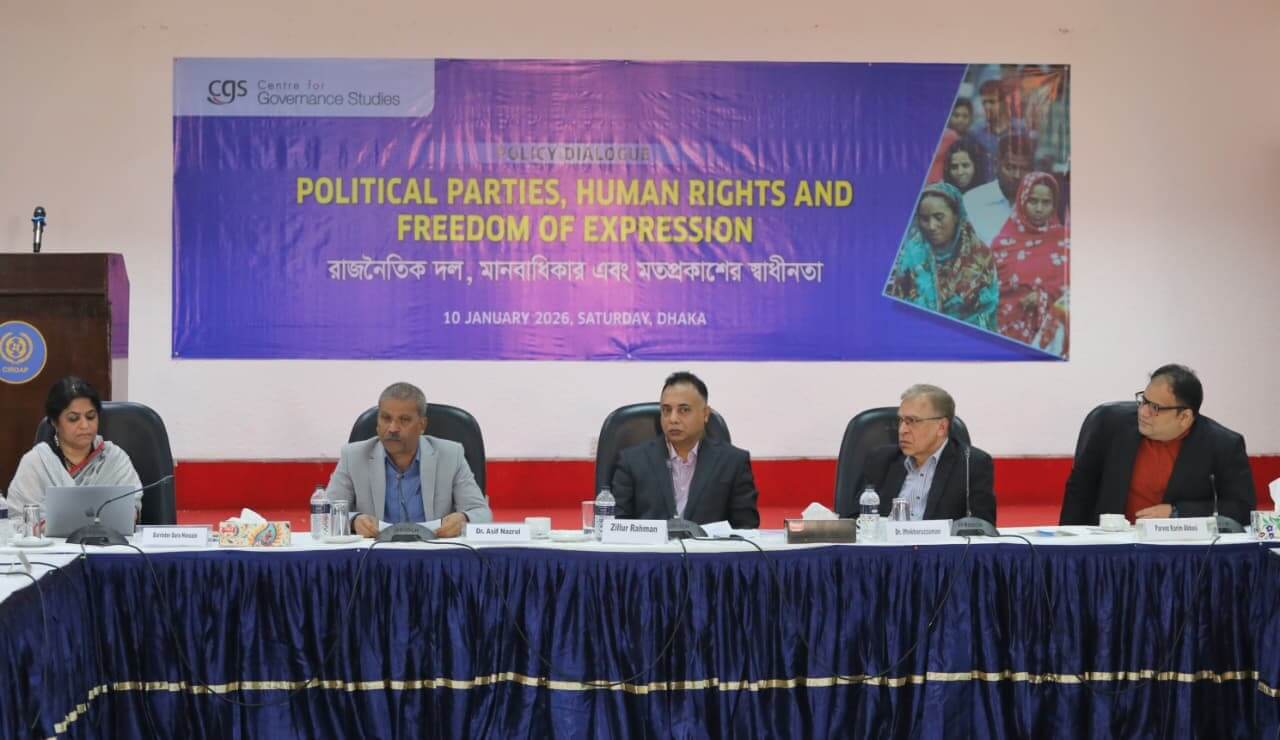
|

Press Release
10 January 2026
Speakers at a CGS Policy Dialogue
Freedom of expression belongs to everyone except the government
– Adviser Dr Asif Nazrul
Political parties must move beyond the conflicts of religion, money, and power
– Dr Iftekharuzzaman
Despite amendments to Section 54 of the Code of Criminal Procedure, its application remains flawed – Barrister Sara Hossain
The Centre for Governance Studies (CGS) organized a policy dialogue titled “Political Parties, Human Rights, and Freedom of Expression”. The discussion was held on Saturday, 10 January 2026, at the CIRDAP Auditorium (Centre on Integrated Rural Development for Asia and the Pacific) in Dhaka. Political leaders, civil society representatives, academics, lawyers, journalists, and human rights activists participated in the dialogue. The discussion focused on the extent to which human rights and freedom of expression are reflected in political discourse in the context of the upcoming national election.
The speakers included Dr Asif Nazrul, Adviser on Law, Justice and Parliamentary Affairs of the Interim Government; Dr Iftekharuzzaman, Executive Director of Transparency International Bangladesh (TIB); Barrister Sara Hossain, Executive Director of Bangladesh Legal Aid and Services Trust (BLAST); Md Muktadir Rashid Romeo, Senior journalist; Bazlur Rashid Firoz, General Secretary of the Bangladesh Socialist Party (BASAD); Md Golam Mostafa, Advocate of the Bangladesh Supreme Court; Professor Dr Abdul Latif Masum of Jahangirnagar University; Didar Bhuiyan, Joint General Secretary of the RastroSongskar Andolon; Sheikh Fazlul Karim Maruf, Central Publicity and Dawah Secretary of Islami Andolon Bangladesh; Nasreen Sultana Mily, Joint General Secretary of AB Party; Parvez Karim Abbasi, Executive Director of the Centre for Governance Studies; Faruk Hasan, Senior Vice-President of Gono Odhikar Parishad; senior journalist Abu Sayeed Khan;Pallab Chakma, Executive Director of Kapaeeng Foundation; Barrister Shihab Uddin Khan, Advocate and BNP leader; Zillur Rahman, President of the Centre for Governance Studies; Ragib Ahsan Munna, Presidium Member of the Communist Party of Bangladesh (CPB); Mosharraf Ahmed Thakur, university teacher and political activist, among others.
At the beginning of the programme, CGS President Zillur Rahman stated that as elections approach, human rights and freedom of expression tend to shrink further. Laws are easily turned into political tools, while violence, clashes, threats, and harassment become difficult to control. Although people speak of democracy and reform, there remains deep skepticism about the Consensus Commission, despite some renewed hope created by political parties sitting together. He questioned whether the rule of law truly exists in Bangladesh, noting that court cases take years to conclude and that freedom of expression remains fragile. He referred to attacks on media outlets such as Prothom Alo and The Daily Star and described these incidents as clear failures of law enforcement. He recalled that during the previous Awami League period, people feared enforced disappearance for speaking out, while now mob culture has become prevalent. He questioned how such incidents could occur in a supposedly stable country and where the government and law enforcement agencies were at the time. He also criticized the lack of a healthy electoral culture over the past 54 years, the dismissal of journalists, changes in media ownership, and the misuse of intelligence agencies.
Dr Asif Nazrul, Adviser to the Interim Government, said that freedom of expression belongs to everyone except the government. He noted that significant reforms have been undertaken, including transferring key judicial matters to the higher courts, enacting a human rights law that he described as one of the strongest in South Asia, and expanding legal aid services that now benefit ten times more people than before. He claimed that the Digital Security Act has improved by 90 percent and that more than 20,000 cases have been resolved. He acknowledged widespread cyberbullying against him following the July uprising and emphasized that comprehensive reform requires time. He stressed the need for self-reflection by political parties and the media, calling for honesty, conscience, tolerance, and accountability to move the country forward over the next five to ten years.
Dr Iftekharuzzamanstated that human rights are universal and not relative. He argued that political parties in Bangladesh capitalize on money, power, and religion, and that the state is enabling the growth of mob power. He urged political parties to engage in self-reflection and include Indigenous peoples’ rights in their election manifestos. He emphasized the importance of upholding the country’s founding principles and called for the elimination of conflicts driven by money, power, and religion. He also advocated for the enactment and implementation of an anti-discrimination law after the election and demanded clarity from political parties on issues to be decided through referendums.
Barrister Sara Hossain noted that although Section 54 of the Code of Criminal Procedure has been amended, its implementation remains deeply problematic. She rejected claims that courts had indiscriminately granted bail in the past. She questioned why journalists now hesitate to report on enforced disappearances and killings, pointing to fear of being targeted. She stressed the absence of genuine consensus-building and warned against labeling certain communities as “minorities” while ignoring unequal access to rights. She highlighted that mob violence disproportionately affects specific groups and urged political parties to assess whether their supporters genuinely stand for human rights and freedom of expression. She also called for critical discussion of colonial-era laws such as blasphemy, anti-terrorism, and defamation statutes, and emphasized the need for inclusion and public awareness.
Nasreen Sultana Mily observed that in the lead-up to the election, smaller parties are being fragmented by exploiting people’s greed, often resulting in the emergence of a single “supreme leader” who eventually becomes a cult figure and fuels authoritarianism. She argued that a deeply entrenched culture of submission has developed over the past 17 years and criticized the Election Commission for appearing to favor the party widely perceived as likely to win.
Advocate Golam Mostafa stated that ordinary citizens have suffered significantly amid political transitions, as those in power secure their interests while the public bears the consequences. He emphasized the need for protecting human rights and decentralizing power.
Journalist Abu Sayeed Khan pointed out the government’s weakness in dealing with mob violence and warned that mobs are becoming more powerful than court verdicts. He stressed that tolerance of criticism is essential for national progress and argued that the government has failed to create a conducive environment for law and order and credible elections.
Professor Dr Abdul Latif Masum highlighted the deep connection between democracy and human rights, criticizing the tendency of ruling parties to politicize law enforcement, bureaucracy, and the judiciary for partisan interests.
Journalist Md Muktadir Rashid Romeo questioned whether freedom of expression now belongs to citizens or to mobs. He described Bangladesh as increasingly fragmented, with competing political narratives and ineffective commissions. He noted that accusations of being a foreign agent have replaced meaningful debate, and asserted that media freedom has long been absent.
Didar Bhuiyan questioned why governance and election commission reforms were excluded from discussions within the Consensus Commission and argued that the Election Commission resists reforms that would enhance its independence.
Ragib Ahsan Munna spoke about global power politics, citing the prosecution of Venezuela’s President in a US court, and warned that imperial ambitions continue to undermine sovereignty and human rights worldwide.
Parvez Karim Abbasi, Executive Director of CGS, stressed the need to give due importance to human rights and freedom of expression. He questioned whether political parties themselves allow free expression internally and criticized the culture of personality worship and unfulfilled promises after gaining power.
Faruk Hasan described the 2026 election as a pre-engineered process, arguing that major parties are co-opting smaller ones and suppressing dissent.
Pallab Chakma stated that despite annual reporting on human rights violations, the situation continues to deteriorate, with inadequate responses from both the government and political parties to communal violence.
Barrister Shihab Uddin Khan asserted that political parties in Bangladesh routinely violate human rights and lack internal democracy. He criticized the “winner-takes-all” approach and noted that no action has been taken against institutions responsible for human rights abuses following the July uprising.
Sheikh Fazlul Karim Maruf described rights as relative but stressed that freedom of expression must be ensured for all to achieve justice. He warned that mob violence is becoming a political tool and criticized the government’s lenient stance.
The program was moderated by Zillur Rahman, President of the Centre for Governance Studies.
About Centre for Governance Studies-
CGS is a think tank based in Bangladesh conducting research and media studies on issues of Good Governance, Corruption, Human Rights, Democracy, and Development. The Centre was established to address the challenges for Bangladesh in coping with the rapidly changing national and global scenarios. The Centre aims at facilitating collaborative efforts among the academic community, government, private sector, civil society and development partners to improve the quality of governance, address the security needs of Bangladesh, foster the conditions for efficient and prudent utilisation of available resources towards poverty reduction, human resource development, and stabilisation of political and social order through increased democratisation, participation and sustainable economic development.
For more queries-
Sanjoy Debnath
Public Relations Coordinator
Centre for Governance Studies
E-mail: [email protected]
Contact No: +880171790853