
Open Forum Discussion: Democratic Reconstruction for Digital Economy and Entrepreneurship
06 January 2026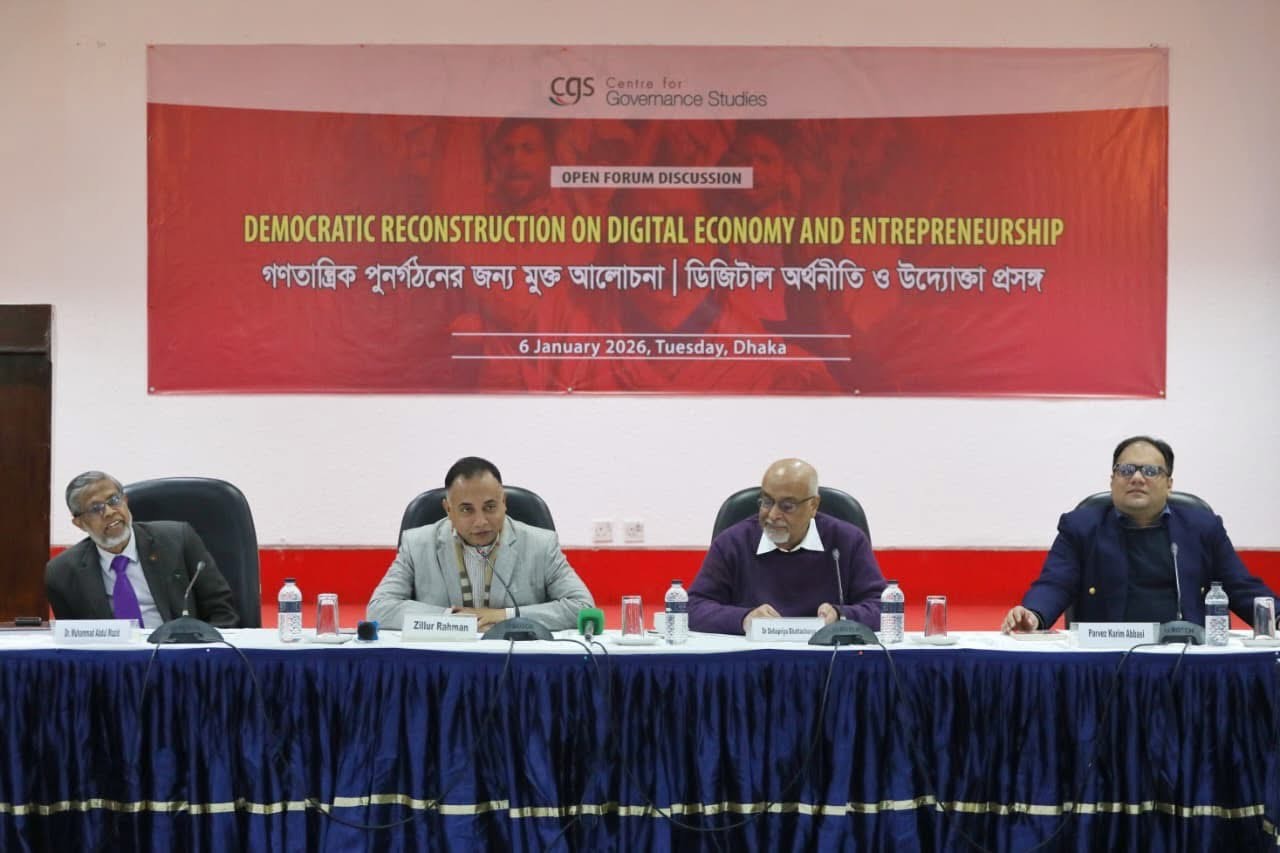
The Centre for Governance Studies (CGS) organised a policy dialogue on Digital Economy and Entrepreneurship on 6 January 2026 at the CIRDAP Auditorium in Dhaka, bringing together economists, business leaders, academics, entrepreneurs, bankers, political representatives, and civil society voices to reflect on the promises and pitfalls of digitalisation in Bangladesh. The discussion took place amid growing concerns over the misuse of digital technologies, widening inequality, and the impact of artificial intelligence and social media on democratic processes, particularly in the context of upcoming elections.
Moderating the session, CGS President Zillur Rahman situated the dialogue within the broader framework of democratic reconstruction following the mass uprising. He questioned the real influence of policy dialogues and think tanks on decision-making in Bangladesh, noting that government engagement with such platforms often remains superficial. Reflecting on the country’s long-standing emphasis on “digitalisation,” he argued that access to mobile phones alone does not constitute a digital state. Under the banner of digital progress, he said, large-scale financial crimes have taken place, including the theft of public funds, while the institutional capacity to prevent or respond to such abuses has remained weak. He also raised concerns about the erosion of trust in mainstream media and the uncritical reliance on social media as a source of information.
Speakers broadly agreed that digitalisation has brought both opportunities and new forms of inequality. While technological advancement has generated employment and simplified processes across sectors, it has also disrupted traditional jobs and deepened socio-economic divides. The internet shutdown during the August movement was cited as a stark reminder of how central digital connectivity has become, as well as a moral failure that exposed the state’s approach to dissent. Several participants warned that the increasing use of social media and artificial intelligence in political campaigning poses serious risks to electoral integrity, especially in the absence of effective regulation or oversight by the Election Commission and other authorities.
Concerns were raised about the state’s limited preparedness to manage the negative consequences of digital transformation. Participants noted that while digital tools have reduced corruption in certain areas, such as service delivery and industrial monitoring, weak governance and poor accountability continue to undermine their benefits. The absence of a unified, credible national data system was identified as a major policy gap, alongside calls for any such system to remain independent, transparent, and free from political control. The need to legitimise and strengthen the Cyber Security Ordinance through democratic processes was also emphasised.
The dialogue further explored the role of digitalisation in entrepreneurship and industrial growth. Speakers highlighted how automation, surveillance technologies, and remote troubleshooting have improved efficiency in manufacturing and reduced opportunities for bribery. At the same time, they stressed that Bangladesh lacks the financial capacity to rely on foreign experts, making investment in domestic IT talent and youth entrepreneurship essential. Several participants argued that digital infrastructure alone is insufficient without corresponding changes in mindset, ethics, and institutional culture.
Education and skills development emerged as recurring concerns. Participants questioned the quality of communication, digital literacy, and ethical training within the education system, warning that technological adoption without human capacity development would fail to deliver meaningful progress. Comparisons were drawn with neighbouring countries that have successfully produced global technology leaders, prompting reflection on Bangladesh’s own shortcomings in nurturing talent. Calls were made to integrate digital education more effectively into academic curricula and to strengthen linkages between education, finance, and entrepreneurship.
Entrepreneurs shared firsthand accounts of the challenges they face in accessing finance, navigating bureaucratic barriers, and protecting themselves from digital fraud. While online platforms such as Facebook and Instagram have enabled business growth, they have also exposed entrepreneurs to scams and financial losses, often without adequate institutional support. Participants stressed that for small and medium enterprises to thrive, one-stop digital solutions, reliable infrastructure, and equitable access to credit are essential, particularly outside major urban centres.
Several speakers expressed concern that economic and political reforms continue to overlook the realities faced by ordinary entrepreneurs and workers. They cautioned against adopting economic models borrowed from other countries without adapting them to local conditions, noting that large capital-backed companies increasingly displace small entrepreneurs. The persistence of weak governance, lack of accountability, and resistance to reform among political elites were identified as key obstacles to building a resilient digital economy.
The discussion concluded with a shared recognition that the digital economy cannot be treated as a standalone sector, but must be understood as complementary to the broader economy and democratic system. Participants stressed that without good governance, ethical leadership, digital literacy, and inclusive policies, technological progress risks reinforcing inequality and mistrust rather than driving sustainable development. The dialogue underscored the urgency of aligning digital transformation with democratic accountability, youth empowerment, and institutional reform at a critical moment in Bangladesh’s political and economic transition.