
Open Forum Discussion: Democratic Reconstruction on Youth Employment
13 December 2025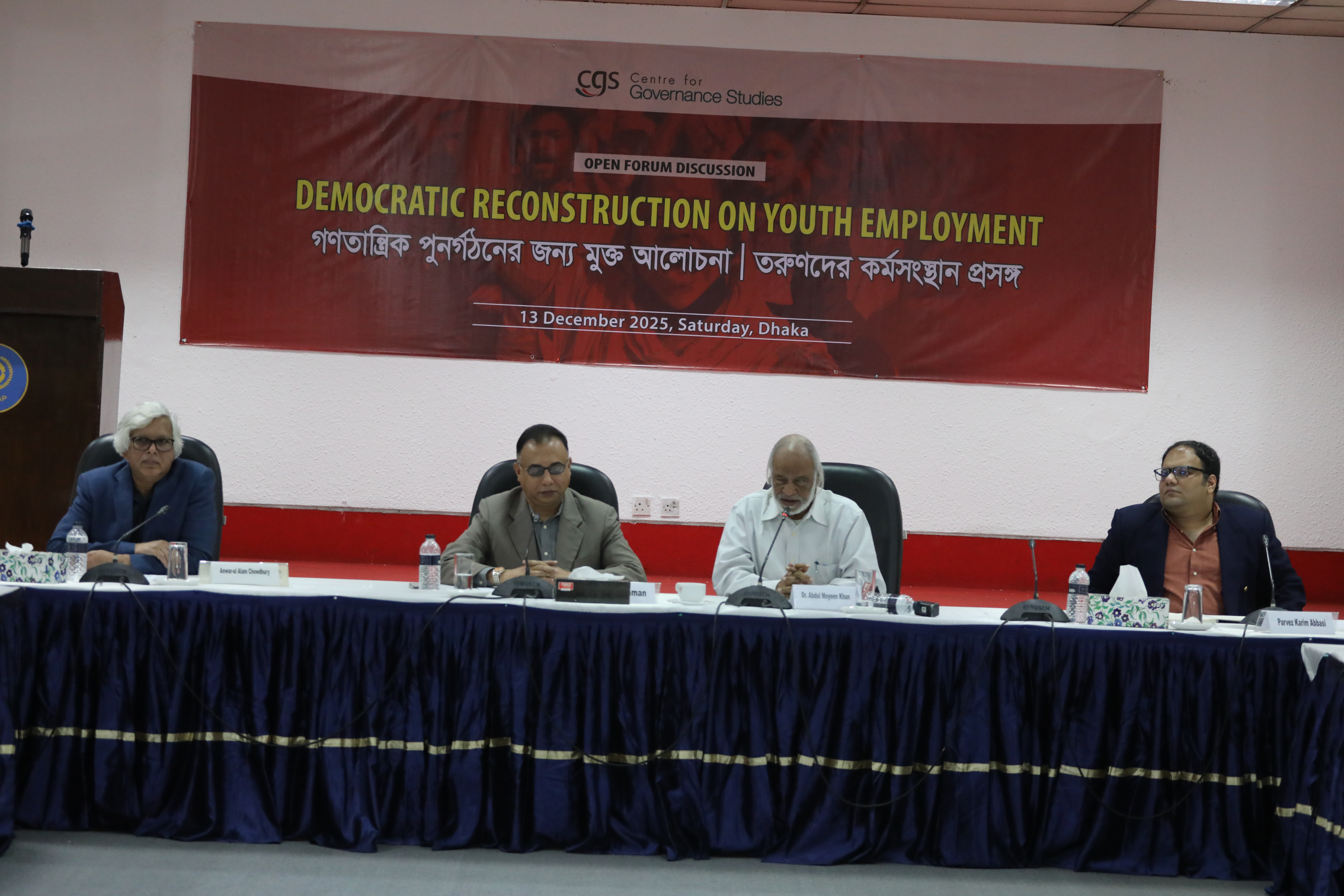
The Centre for Governance Studies (CGS) organised an open forum discussion titled “Democratic Reconstruction on Youth Employment” on 13 December 2025 at the CIRDAP Auditorium in Dhaka. The forum brought together political leaders, economists, academics, university administrators, labour rights advocates, entrepreneurs, and civil society representatives to examine the growing crisis of youth unemployment and its implications for Bangladesh’s democratic and economic future. The discussion took place amid rising unemployment, increasing poverty, and widespread concern that the country’s demographic dividend is rapidly turning into a liability.
Moderating the session, CGS President Zillur Rahman noted that the July–August uprising was largely driven by young people, yet many of those same youth are now disillusioned. With nearly one-third of the population under the age of 35, he warned that educated unemployment poses a serious challenge to democratic stability. He argued that youth participation should not be reduced to symbolic representation in parliament or ministerial positions, but instead must be understood as a long-term process that allows young people to gain experience, skills, and meaningful opportunities within society.
Speakers repeatedly highlighted that Bangladesh’s employment crisis cannot be understood through headline statistics alone. While official unemployment figures appear relatively low, several participants argued that these numbers fail to capture the reality of disguised unemployment, underemployment, and job insecurity. In rural areas, multiple income sources often blur the line between employment and survival, while in urban settings a growing number of educated youths remain either unemployed or trapped in low-quality, informal work. Concerns were raised that unreliable data and weak labour market assessments continue to undermine effective policymaking.
The discussion also examined structural weaknesses within the economy. Participants noted that overseas employment and the ready-made garments sector remain the primary drivers of growth, but these sectors alone are insufficient to absorb the growing number of job seekers. Rising global uncertainty, increasing tariffs, high interest rates, and limited access to raw materials were identified as major constraints on job creation. Several speakers warned that without diversification and investment in new sectors—particularly digital infrastructure and technology-based industries—Bangladesh risks losing competitiveness in a rapidly shifting global economy.
Education and skills mismatch emerged as one of the most critical concerns. Participants pointed out that the proportion of unemployed youth is significantly higher among graduates, raising serious questions about the relevance of the education system. Universities were criticised for failing to align curricula with labour market demands, while technical and vocational education was described as poorly regulated and, in some cases, commercially driven. Speakers emphasised that rote learning continues to dominate, leaving graduates ill-prepared for both domestic and international job markets.
Gender disparities in employment were also discussed at length. Speakers noted that women’s participation in high-skill and managerial positions remains limited, despite their educational attainment. The absence of institutional support mechanisms—such as daycare facilities in urban and industrial areas—was identified as a major barrier to women’s sustained participation in the workforce. Several participants stressed that improving women’s employment is not only a social issue but a critical economic necessity.
Beyond economics, the forum addressed deeper political and social challenges affecting youth. Mob culture, political violence, drug abuse, and corruption were described as factors eroding young people’s trust in the state. Some speakers argued that state policies have historically worked against youth empowerment, creating conditions that keep young people dependent, discouraged, or forced into precarious overseas employment. The informal sector, which employs a vast share of the workforce, was described as both a source of resilience and a missed opportunity due to the absence of meaningful formalisationefforts.
Several participants stressed that youth unemployment is not merely an economic problem but a democratic one. The persistence of bribery in recruitment, inequality in access to public sector jobs, and the long-standing quota system were cited as sources of frustration and resentment among young people. Without credible reforms, speakers warned, unemployment could further fuel social unrest, migration, and loss of faith in democratic institutions.
The discussion concluded with a shared recognition that youth employment must be placed at the centre of democratic reconstruction in Bangladesh. Participants emphasised that sustainable employment requires coordinated action across education reform, skills development, private sector engagement, and accountable governance. Without moving beyond rhetoric and short-term promises, they cautioned, Bangladesh risks squandering the energy, creativity, and potential of its largest generation at a critical juncture in the country’s political and economic transition