
Open Forum Discussion: Democratic Reconstruction of Labour Rights
09 October 2025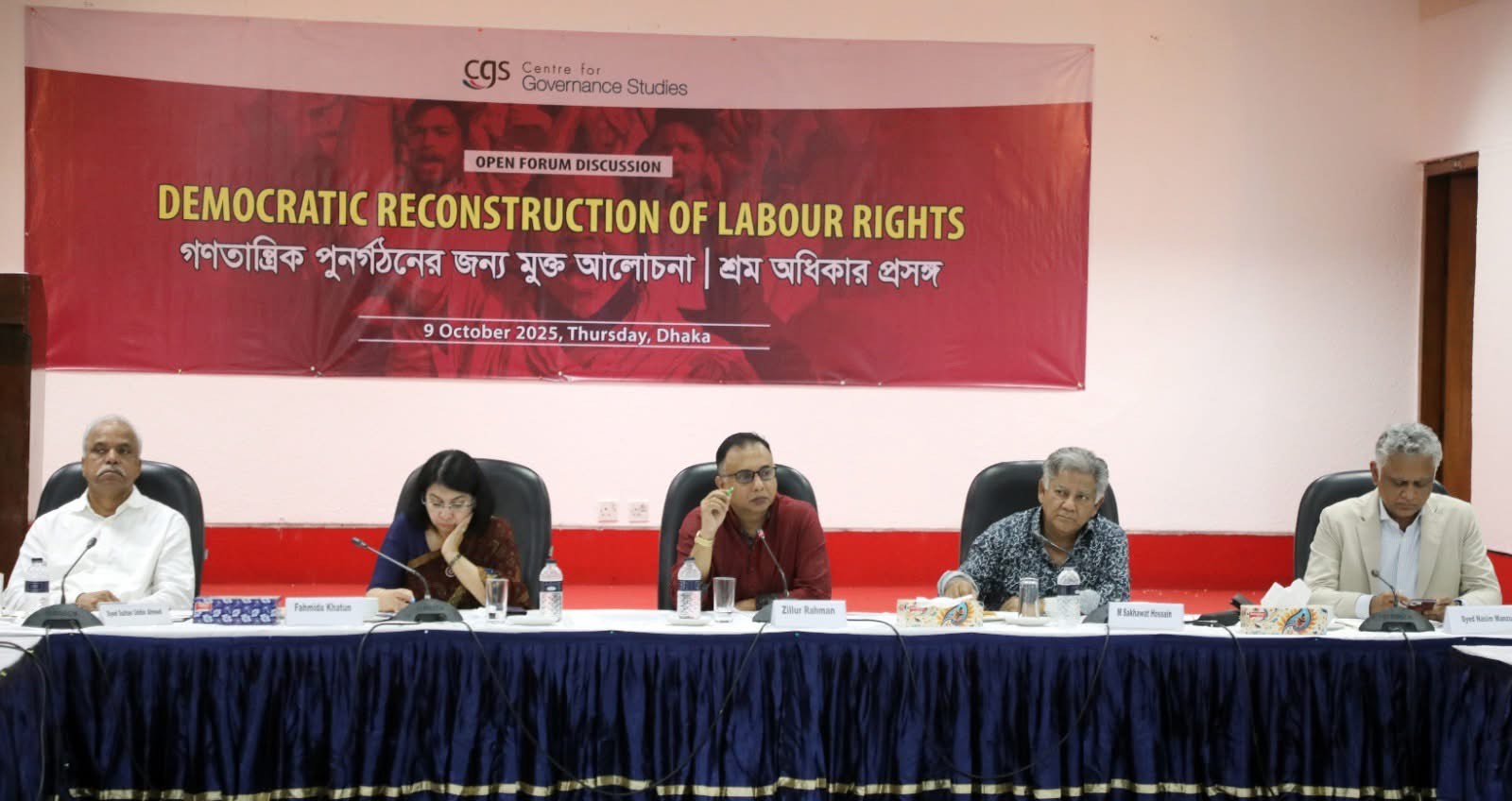
The Centre for Governance Studies (CGS) organised aan Open forum Discussion titled “Democratic Reconstuction on Labour Rights” on 9th October 2025 at the CIRDAP Auditorium in Dhaka, bringing together economists, labour leaders, academics, business representatives, entrepreneurs, and civil society actors to examine the state of economic reform, labour governance, and democratic accountability in Bangladesh. The discussion took place against the backdrop of post-July political changes, rising unemployment, labour unrest, and growing uncertainty over the direction and depth of ongoing reform initiatives.
Moderating the dialogue, CGS President Zillur Rahman observed that although reform has remained a recurring promise in Bangladesh since 2007–08, meaningful implementation has largely failed to materialise. He noted that successive governments have formed multiple commissions, yet their recommendations have rarely translated into systemic change. Emphasising that elections alone do not define democracy, he stressed that democratic principles must be embedded across institutions if reform efforts are to be credible and sustainable.
Speakers raised serious concerns about labour governance and the persistent exclusion of workers from reform agendas. Despite amendments to labour laws and some regulatory progress, democratic practices within trade unions remain weak, while workers in both formal and informal sectors continue to face harassment, intimidation, and criminal cases when they attempt to organise. Participants highlighted that nearly 85 percent of Bangladesh’s workforce remains in the informal sector, largely outside the reach of labour protections, social security, or effective policy oversight.
The discussion also focused on Bangladesh’s increasing economic vulnerability in a rapidly changing global environment. Rising tariffs in key export markets, high interest rates, limited access to raw materials, and a lack of export diversification were identified as major challenges for entrepreneurs and businesses. Several speakers argued that while interest rate hikes may help control inflation, they have simultaneously constrained business growth and job creation, particularly for small and medium enterprises. Concerns were raised that without substantial investment in human resources and skills development, Bangladesh risks losing competitiveness following its graduation from least developed country status.
Issues of workers’ dignity, safety, and social protection featured prominently throughout the dialogue. Participants criticised the continued absence of effective investigations into industrial accidents, factory fires, and worker deaths, as well as the unequal treatment of workers compared to civil servants in areas such as maternity leave, healthcare, and retirement benefits. The lack of worker-focused healthcare facilities in industrial zones and the exclusion of workers, especially women and informal labourers, from social safety nets were described as structural policy failures.
Several speakers expressed frustration over what they described as reform fatigue, noting that while commissions and discussions are repeatedly announced, workers’ rights and welfare remain marginalised. Questions were raised as to why labour issues continue to be excluded from national reform priorities, despite workers’ visible role in recent protests and movements. The concentration of economic power, capital flight, and money laundering were also highlighted as factors undermining democratic accountability and equitable development.
The dialogue concluded with a shared recognition that democratic reconstruction in Bangladesh cannot be achieved without addressing labour rights, employment security, and economic justice. Participants stressed that workers are not peripheral to development but central to sustaining economic growth and social stability. Without enforceable labour laws, accountable institutions, and inclusive economic policies, speakers warned, reform efforts will remain superficial, deepening inequality and eroding public trust at a critical moment in Bangladesh’s political and economic trajectory.