
Min Aung Hlaing: A Presidency Shaped by Military Power
Jahanara Jaba | 31 March 2026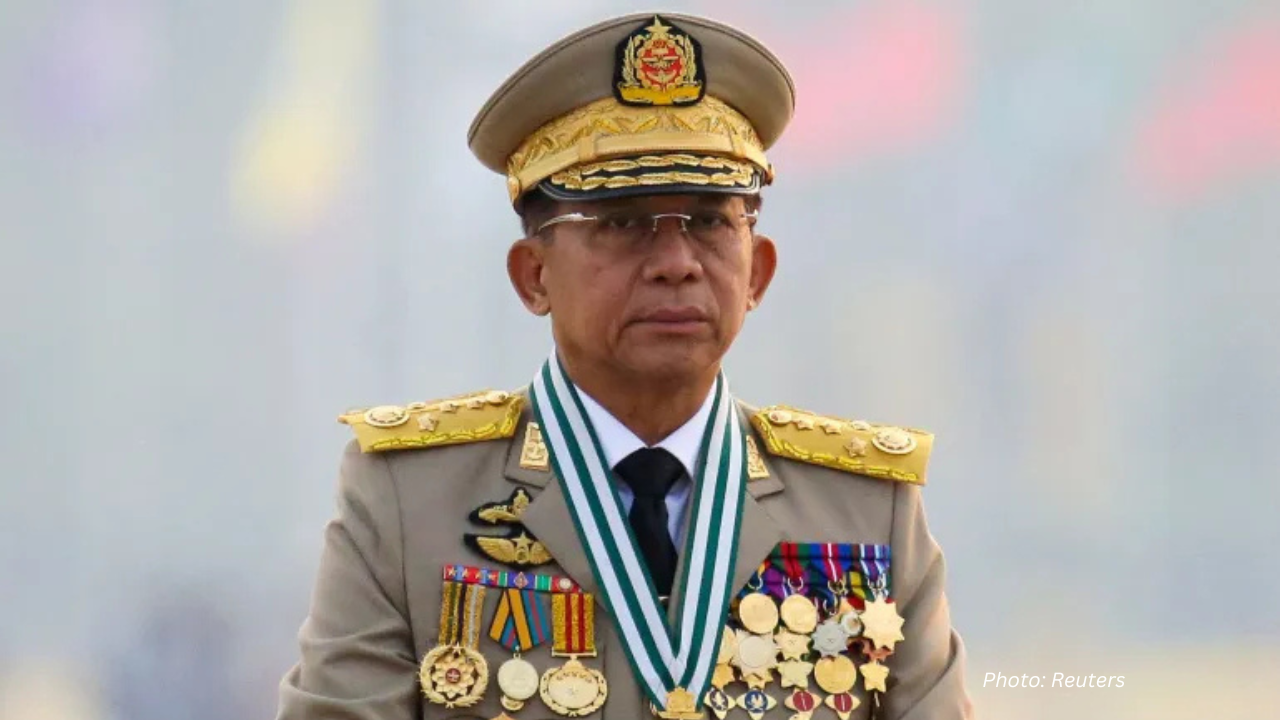
As Myanmar’s former commander-in-chief, on March 30, 2026, Min Aung Hlaing officially became a presidential candidate in the country, marking a new stage in the political transition in Myanmar since the 2021 coup. His resignation was occasioned by the fact that a new parliament had just started the constitutional process of a new president being elected after a contentious general election that was won by the military-supported Union Solidarity and Development Party. Later that day, Ye Win Oo, an inner circle loyalist of Min Aung Hlaing, assumed the role of commander-in-chief, suggesting continuity in the military as power was being rebalanced through civilian office. Far from signaling normalization, this latest development reflects the junta’s attempt to consolidate power, seek a degree of international legitimacy, and institutionalize military rule through constitutional theater.
Analysts described the move as the culmination of Min Aung Hlaing’s long-held ambition to become president, shifting from direct military rule to a nominally civilian administration without changing the underlying power structure. The presidential election was carried out within the parliamentary system of Myanmar and not in a popular vote. Presidential candidates would be nominated by the military bloc and the two houses of parliament via different avenues, and then one of the nominees would be elected to the position of the president, leaving the rest to be the vice presidents. The parliamentary balance that was formed by the general election was the core of the presidential race. The resignation of military office by Min Aung Hlaing was also a necessary procedure, as the constitution prohibits a civil servant in service to run against the presidency.
Ever since the military overthrew the elected government of Aung San Suu Kyi, Myanmar has been stuck in a long-lasting crisis of conflict, repression, and displacement. The 2025-2026 election, in that environment, was a step backwards to constitutional governance yet the political environment was highly controlled.
The parliamentary election held in phases during December 2025 and January 2026 was widely criticized for lacking credibility. Reuters reported that the polls were condemned by the United Nations and many Western governments, while also noting that Suu Kyi’s party and other opposition groups were excluded from participation, effectively clearing the way for the military-backed USDP to dominate the outcome. The Guardian similarly described the vote as a “sham” election that served to provide formal cover for continued military influence rather than to open real democratic competition.
Under these conditions, parliament was created, which made the way of Min Aung Hlaing to the presidency even more obvious. On March 30, he was nominated in the lower house as a vice-presidential candidate, and the other nominations would be finalized through the other channels of the parliament before the final vote. This phase was more of an administration-led transition process than a competitive political battle. The parliamentary election was, in fact, not only important in the result of the seats, but in the manner, it organized the playing field to the presidential result that would come afterward.
What is more important about this change is the insight about the junta survival strategy. Ever since the coup overthrew the elected government of Aung San Suu Kyi in February 2021 Myanmar has been plunged into a catastrophic civil war. According to a report by Reuters, the war has claimed the lives of almost 93,000 individuals and displaced over 3.6 million. Based on estimates given by the UN, indicate that at least 6,800 civilians have been killed and approximately 40 percent of the population is now short of food and aid, an important point to note on the extent of the humanitarian meltdown.
Collectively, a chain between the resignation to presidential election is an indication of a controlled shift in form but not the change in content. The step of Min Aung Hlaing out of the military command and the appointment of a loyal successor, the arrangement of a parliamentary election under limited circumstances, and the final vote in a pro-military parliament all indicate an attempt to establish the power of the junta through civilian means instead of its dissolution. Here the presidency does not seem the onset of a new democratic era, but the extension of military hegemony, in a new constitutional form.
The real question, however, is not whether Min Aung Hlaing currently uses a civilian title. Whether Myanmar is any nearer to peace, accountability, pluralism, or democratic restoration. It is no on the evidence so far. His presidency seems tailored to centralize power, control elite loyalties and to ease the image of the regime in the outside world, rather than to liberate political space in the domestic arena. As long as opposition forces are not permitted meaningful participation, political prisoners are freed, and the military control over the institutions of the state is truly weakened, it will continue being what it is today, not a democratic transition, but a managed rebranding of military rule.
• Jahanara Jaba is a Research Intern at the Centre for Governance Studies (CGS)
Disclaimer: Views in this article are author’s own and do not necessarily reflect CGS policy