
Report on the Event of Meet the Ambassador: France
Date: 29 July 2026 | 29 July 2026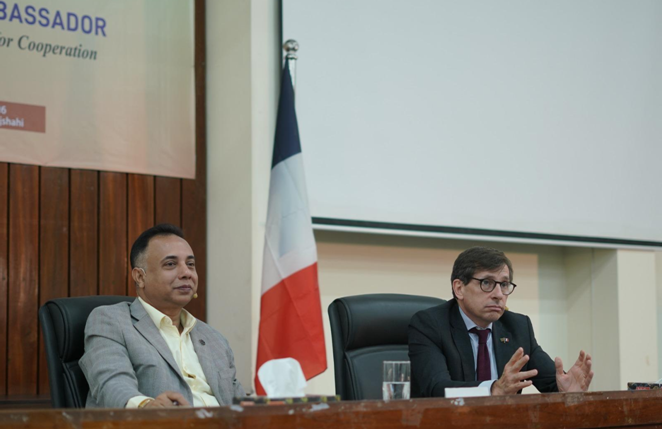
On Wednesday, 29 July 2026, the Centre for Governance Studies (CGS), in collaboration with Friedrich-Ebert-Stiftung (FES) Bangladesh, organized the second phase of the “Meet the Ambassador” series at the Senate Hall of the University of Rajshahi. H.E. Jean-Marc Séré-Charlet, Ambassador of France to Bangladesh, participated in the programme as the featured speaker. The session focused on the evolving relationship between Bangladesh and France, with particular attention to bilateral cooperation, higher education, investment, climate change, human rights, the Rohingya crisis, the Indo-Pacific, cultural exchange, and people-to-people relations.
Dr. Felix Gerdes, Resident Representative of Friedrich-Ebert-Stiftung Bangladesh, inaugurated the programme with his remarks. He explained that FES, founded in 1925 and named after Germany’s first democratically elected president, works internationally to promote democracy through research, training, and public debate, with particular emphasis on labour rights and civic education. Operating in around 100 countries, FES seeks to strengthen international cooperation and, in Bangladesh, focuses on labour issues, fair economic policy, and other areas of cooperation.
Speaking about the “Meet the Ambassador” initiative, Dr. Gerdes said the programme, jointly organized with the Centre for Governance Studies, aims to deepen public understanding of the foreign policy positions of different countries while also creating opportunities for Bangladeshi society to engage directly with foreign diplomats. He emphasized that such engagement allows participants not only to understand the perspectives of international partners but also to communicate Bangladesh’s own views and priorities. He thanked the University of Rajshahi for hosting the event and expressed hope that the session would generate a stimulating and meaningful discussion.
Professor Dr. Md. Abdul Alim, Pro Vice-Chancellor of the University of Rajshahi, welcomed the participants and highlighted the importance of exposing students to international affairs at a time of profound political, economic, technological, and environmental change. He noted that young people are pursuing their education in an increasingly complex global environment shaped by climate change, conflict, migration, economic uncertainty, disinformation, and rapid technological transformation.
Professor Alim encouraged students to remain curious, move beyond textbook-based learning, and develop an understanding of international developments from a variety of perspectives. He emphasized the importance of strengthening analytical, digital, and intercultural skills so that students can respond effectively to emerging global challenges. Referring to the longstanding friendship between Bangladesh and France, he highlighted growing cooperation in education, culture, trade, climate action, and technology. He expressed hope that the French Ambassador’s visit to the University of Rajshahi would contribute to stronger academic collaboration and deeper people-to-people relations between the two countries.
Zillur Rahman, President of CGS and moderator of the session, began by expressing his pleasure at visiting the University of Rajshahi for the first time. He referred to Rajshahi’s reputation as a city of education, culture, silk, and mangoes and described the university as a longstanding centre of knowledge. He observed that universities are not merely collections of buildings but important spaces where ideas meet and people learn to engage with diverse perspectives.
He further emphasized that diplomacy is ultimately about people and connections. Highlighting the longstanding warm relationship between Bangladesh and France, he referred to cooperation in trade, culture, education, climate action, development, technology, and international affairs. Against the backdrop of a rapidly changing international environment, he described the discussion as particularly timely and relevant.
During his excellency's remarks, Jean-Marc Séré-Charlet, Ambassador of France to Bangladesh, emphasized the importance of ensuring equal participation of women and men in diplomacy, policymaking, and public life. Referring to France’s feminist foreign policy, he argued that greater space should be created for women in international affairs and that fundamental rights must be protected regardless of gender, identity, or background.
Addressing contemporary global challenges, the Ambassador stressed the urgency of collective action on climate change. He underlined that humanity has only one planet and therefore countries must work together to protect the environment for future generations. He noted that conflicts, violence, human rights violations, and political instability have created serious challenges across different regions of the world, making cooperation between countries increasingly important.
The Ambassador emphasized the need to strengthen regional cooperation, bilateral partnerships, multilateral institutions, and respect for international law. He expressed concern that the international community often struggles to act collectively in support of people facing violence and human rights abuses. Countries, he argued, should defend shared values and principles while continuing to seek peaceful and coordinated solutions to global crises.
He also cautioned against viewing the international system primarily through broad labels such as the “Global South” or the “Collective West,” observing that such terminology does not always adequately reflect the diversity of individual countries and societies. Instead, he encouraged greater attention to common interests and opportunities for cooperation, especially in climate action, peace, human rights, and global stability.
Highlighting the longstanding friendship between Bangladesh and France, the Ambassador referred to cooperation in education, culture, archaeology, language, climate action, and people-to-people exchanges. He encouraged greater academic and cultural engagement between the two countries and expressed hope that more citizens and students would travel, study, and develop stronger personal and institutional connections between Bangladesh and France. In particular, he called for increased student mobility, with more Bangladeshi students pursuing higher education in France and more French students coming to Bangladesh for academic and cultural exchanges.
During the moderated conversation, Zillur Rahman raised several major issues concerning Bangladesh–France relations, including investment, education, climate change, the Rohingya crisis, the Indo-Pacific, and Bangladesh’s strategic autonomy. Responding to these issues, Ambassador Jean-Marc Séré-Charlet praised the resilience of the Bangladeshi people and their aspirations for democracy, observing that these values resonate strongly with France. He identified global cooperation, investment in pharmaceuticals and green energy, and stronger cultural relations as three important areas in which bilateral ties could be further expanded.
On investment and economic cooperation, the Ambassador said that attracting greater levels of French investment would require a more open and predictable business environment in Bangladesh. He emphasized the importance of stronger action against corruption, reducing bureaucratic red tape, and establishing clearer investment priorities. He also highlighted the importance of the rule of law, judicial independence, and policy continuity in creating the conditions necessary for long-term foreign investment.
Discussing opportunities in higher education, the Ambassador encouraged Bangladeshi students to consider France as a destination for further study. He referred to the quality of French universities, the diversity of academic opportunities available, and the country's international educational environment. He also noted that an increasing number of programmes are being offered in English, making French higher education more accessible to international students. In this context, he highlighted the role of Campus France in assisting Bangladeshi students who are genuinely interested in pursuing higher education opportunities in France.
On climate change, Ambassador Séré-Charlet highlighted France’s support for initiatives aimed at helping vulnerable communities in Bangladesh adapt to the consequences of climate change. He reaffirmed France’s commitment to the Paris Agreement and to broader international climate action, stressing the importance of collective responsibility in addressing one of the most significant challenges facing the world.
Regarding the Rohingya crisis, the Ambassador said that the international community must continue to support Bangladesh. At the same time, he emphasized that a sustainable solution ultimately depends on achieving peace and stability in Myanmar and creating conditions that would allow the Rohingya to return safely.
Discussing Bangladesh’s position in the Indo-Pacific, the Ambassador encouraged Bangladesh to be more vocal in supporting free passage, peace, and respect for international principles. Addressing Bangladesh’s desire to maintain its sovereignty while developing partnerships with other countries, he argued that international partnership can itself be an expression of sovereignty. He encouraged Bangladesh to strengthen relationships with countries that respect its independence and refrain from exerting undue pressure.
On democracy and human rights, Ambassador Séré-Charlet described the protection of these principles as an ongoing responsibility and emphasized the importance of defending international human rights institutions. He also reiterated France’s longstanding opposition to the death penalty.
Speaking about Bangladesh’s political transition, the Ambassador discussed the country’s electoral process and democratic aspirations. According to the event record, he described the recent election as free, fair, and accepted and viewed it as evidence of the Bangladeshi people’s desire for democracy. He also expressed France’s readiness to work with the elected government and said that part of his mission in Bangladesh was to help relaunch and strengthen relations between France and Bangladesh.
During the question-and-answer session, students and faculty members raised a wide range of issues, including food and energy insecurity, the blue economy, human rights, trade, climate change, education, and global diplomacy. The interactive session gave participants an opportunity to directly engage the Ambassador on both bilateral and broader international issues.
At the conclusion of the programme, Shadhan Kumar Das, Program Advisor of Friedrich-Ebert-Stiftung (FES) Bangladesh, delivered the vote of thanks. In his closing remarks, he conveyed his sincere appreciation to H.E. Jean-Marc Séré-Charlet, Ambassador of France to Bangladesh, for his distinguished presence and for engaging with the audience through an insightful and candid exchange of views. He also expressed gratitude to the University of Rajshahi for graciously hosting the programme and extended his thanks to the university authorities, faculty members, students, invited guests, and all participants whose active engagement contributed to the success of the session. Mr. Das further acknowledged the collaborative efforts of the Centre for Governance Studies (CGS) and FES Bangladesh in convening the event, underscoring the significance of dialogue-driven platforms in broadening young people’s understanding of diplomacy, international relations, democratic values, and global affairs. He expressed hope that such initiatives would continue to foster informed engagement, meaningful exchange, and stronger connections between young citizens and the international community.
The programme was broadcast live on Facebook, enabling a wider audience to follow the discussion beyond the venue. It also received coverage from both local and national news outlets, helping to extend the reach of the event and generate broader public engagement with the issues discussed.
To watch the full programme, please click on the link below.
(539) MEET THE AMBASSADOR Talking Diplomacy for Cooperation - YouTube