
India’s Gen Z Awakening and the Next Stage of Indian Politics
Roman Uddin | 30 July 2026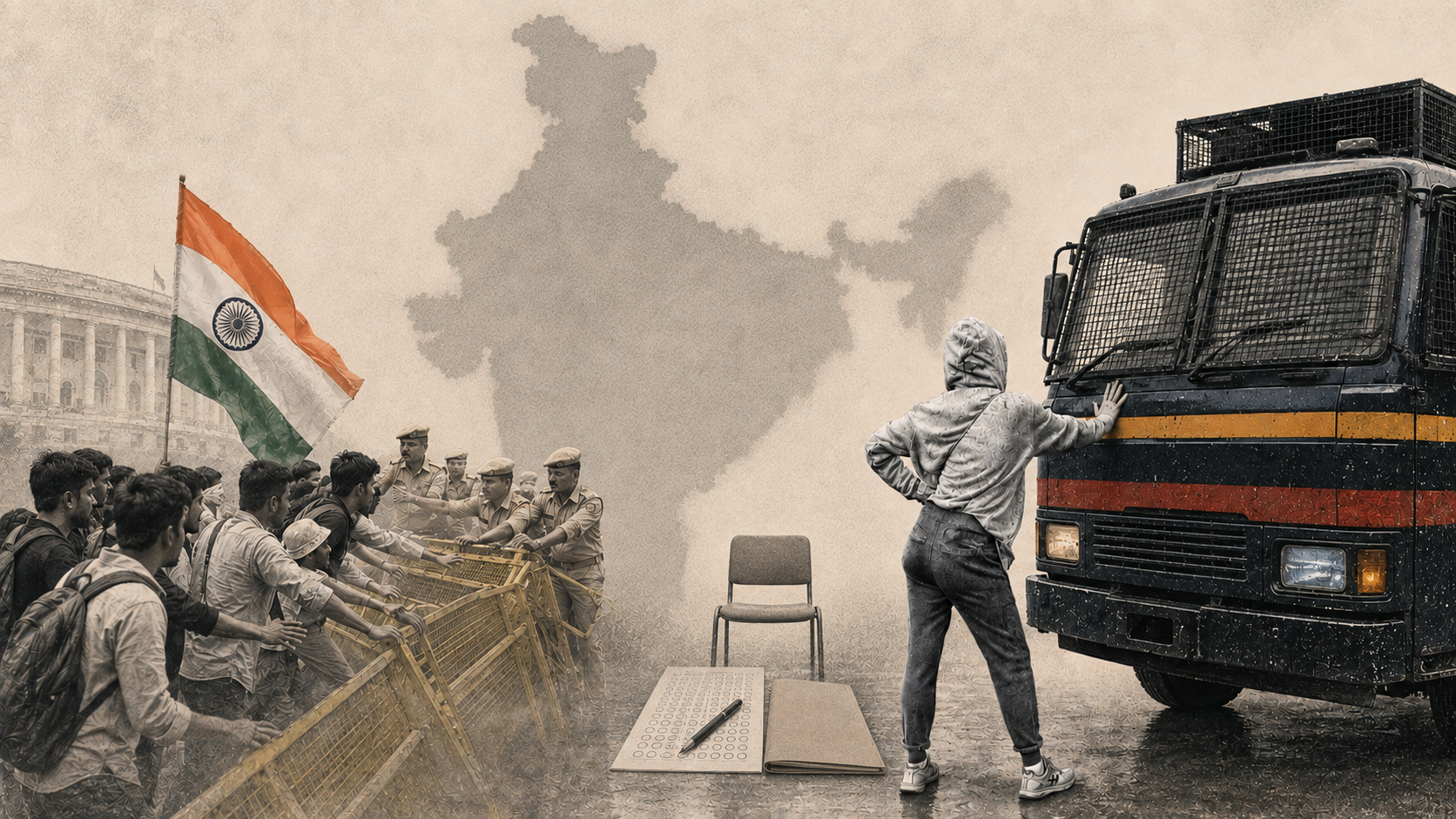
Since 2022, four South Asian countries have watched their youngest citizens take to the streets in ways their governments did not expect. Sri Lanka’s Aragalaya movement forced Mahinda and Gotabaya Rajapaksa to resign, ending the family’s rule in 2022.[1] Bangladesh’s student-led quota reform movement ended a fifteen-year regime of Sheikh Hasina within a few weeks in 2024.[2] Nepal’s Gen Z protests forced Prime Minister K. P. Sharma Oli to resign in September 2025.[3] And in mid-2026, thousands of young Indians gathered at Delhi’s Jantar Mantar under the banner of the Cockroach Janta Party until the country’s education minister stepped down.[4]The recurring question is whether these episodes are unrelated national crises or expressions of one regional transformation. From Colombo to Dhaka, Kathmandu to Delhi, similar frustrations drove these movements. Each showed young people’s anger over the gap between government promises and reality.
Young people react faster to government failure today because information spreads instantly through smartphones. A local grievance can become shared national evidence within minutes. Attempts to control information can therefore intensify public anger. In Nepal, the government banned twenty-six social media platforms in September 2025, prompting strong youth-led protests.[5]In Bangladesh,cthe government shut down the internet in July 2024 to control the quota reform protests. Young people grew angrierand it helped drive the movement that forced Sheikh Hasina’s resignation weeks later.[6]A local failure, once contained, now travels instantly and finds an audience already primed by a similar experience elsewhere. This is also why these movements begin among students and young professionals yet rarely stay confined to them, since a grievance that starts as a campus issue or a lost job application quickly reads as a shared national condition, drawing in parents, workers and older citizens who recognize their own frustrations in it.
India’s own trajectory over the past decade helps situate this pattern. The Bharatiya Janata Party’s rise to national power in 2014 followed ten years of Congress-led rule that had become associated with a series of corruption controversies, including the 2G spectrum and coal block allocation cases, alongside a slowing economy and what political analysis widely termed policy paralysis.[7] The same period saw the 2011 anti-corruption movement led by Anna Hazare, which turned public anger over corruption into a nationwide demand for accountability.[8]Against this backdrop, the BJP under Narendra Modi consolidated a form of populist politics that paired a promise of decisive governance and economic development with the assertion of a majoritarian national identity rooted in Hindu nationalism, alongside an expanding welfare state that delivered benefits to lower-income households.[9] The political scientist Christophe Jaffrelot describes this as a shift toward what he calls an ethnic democracy, where majority religious identity becomes tied to the nation itself, power centers on one leader, and independent institutions face growing pressure.[10] This approach carries real electoral appeal and helped the BJP win three elections in a row.[11] But it is also a model built on identity, symbolism and a single dominant leader, and that is precisely what appears to sit less comfortably with the new generation of voters.
Indian politics has traditionally been shaped by identity. Caste groups influence voting in states like Uttar Pradesh and Bihar. Religion shapes national campaigns, and region and language shape state elections.[12] Gen Z has not rejected the identities outright, but many of them seem tired of a politics built mainly on religion, caste and symbolism. They want to judge the state on a different measure, jobs, healthcare, and access to public information, rather than on which community or ideology it claims to represent.[13] Economic pressure makes this urgent. India’s Periodic Labour Force Survey found that graduate unemployment stood at 11.2 percent in 2025, more than three times the national average.[14] The International Labour Organization’s India Employment Report found that youth made up 83 percent of the country’s jobless population.[15] With internet access reaching 55 percent of India’s population by early 2025, young people can see these numbers instantly, and an uncertain job market makes that comparison feel personal.[16] It is a demand for a different kind of state, one that offers exams without leaks, hiring based on merit, and a real system for handling complaints instead of empty promises.
This makes Gen Z a new and notably impatient kind of political force. It stands apart from the parties, trade unions, farmer groups, and caste organizations that have shaped Indian politics for decades, and it is often critical of that entire old structure, not just of any single party. The Cockroach Janta Party had no formal members, no long-term leader, and no political ideology. Yet it built enough pressure to force a government minister to resign within a few days of its first protest.[17] Nearly one in five of India’s registered voters in 2024 was under thirty years old.[18] This is a large group that older political organizations struggle to represent, because it does not organize around caste, occupation, or region the way earlier generations did. The strength of this new kind of movement is speed. A decentralized, digital protest can grow faster than any political party. Its weakness is that it rarely lasts, since once the immediate demand is met, the movement tends to fade instead of becoming a lasting institution.
One pattern repeats across South Asia. Governments often blame youth protests on foreign interference rather than admit domestic failure. Sheikh Hasina told India’s envoy that “anarchists” were trying to create “Sri Lanka-type mayhem” in Dhaka.[19] A former Indian high commissioner separately suggested a foreign hand was behind Hasina’s fall.[20] In Nepal, some commentators pointed to an “American hand,” even though observers on the ground said the uprising was a domestic response to corruption.[21] India’s own political conversation has used the same idea, blaming Western groups, short sellers, or unnamed conspiracies whenever its institutions face scrutiny.[22] This habit protects governments from accountability by shifting blame elsewhere. But in every case examined here, the evidence points to domestic governance failure, not foreign interference.[23]
None of this means India is close to the kind of collapse seen in Colombo, Dhaka, or Kathmandu. Its institutions are still stronger than those of its neighbors were before their governments fell. The question is whether India can move from politics centered on charismatic leaders to institutions that endure, from symbolic achievements to effective everyday governance, and from national ambition to opportunities that young Indians can genuinely experience in their own lives. Gen Z is not asking India to abandon its identity, religion, or welfare commitments. It is asking that these values not be used to divide society or replace the basic responsibilities of the state. Young Indians want a system that delivers fair exams, honest hiring, and an economy capable of creating opportunities for their generation. Whether India can make that shift will matter more for its democratic future than any single election. India’s Gen Z is not just challenging one government. It is asking for a new definition of success, one measured by what every citizen can still become.
Roman Uddin is a Senior Research Associate at Centre for Governance Studies (CGS)
References
[1]Carnegie Endowment for International Peace. (2025, August). The Aragalaya protest movement and the struggle for political change in Sri Lanka. https://carnegieendowment.org/research/2025/08/sri-lanka-aragalaya-protest-movement-oust-wickremesinghe-rajapaksa
[2]European Union Agency for Asylum. (2025, August 5). Bangladesh: Situation update one year after the students' protests. https://www.euaa.europa.eu/news-events/bangladesh-situation-update-one-year-after-students-protests
[3]Encyclopaedia Britannica. (2025, September 9). 2025 Nepalese Gen Z protests. https://www.britannica.com/event/2025-Nepalese-Gen-Z-Protests
[4]Al Jazeera. (2026, July 25). 'We have done it': Joy as 'Cockroach' protests push India minister out. https://www.aljazeera.com/features/2026/7/25/we-have-done-it-joy-as-cockroach-protests-push-india-minister-out
[5]Rest of World. (2025, November 6). Nepal's Gen Z protests lead to the prime minister's resignation. https://restofworld.org/2025/nepal-gen-z-protest/
[6]The Daily Star. (n.d.). How Gen Z kept connected after the internet shutdown. https://www.thedailystar.net/tech-startup/news/how-gen-z-kept-connected-after-internet-shutdown-3956001
[7]Diwakar, R. (2015). The 16th general election in India, April-May 2014. Electoral Studies, 37, 120-125. https://doi.org/10.1016/j.electstud.2014.11.005
[8]BBC News. (2011, August 28). Anna Hazare's movement, a reality check for India. https://feeds.bbci.co.uk/news/world-south-asia-14699974
[9]Dissent Magazine. (2024, June 4). The BJP's drive for hegemony. https://dissentmagazine.org/article/the-bjps-drive-for-hegemony/
[10]Jaffrelot, C. (2021). Modi's India: Hindu nationalism and the rise of ethnic democracy (C. Schoch, Trans.). Princeton University Press.
[11]Maiorano, D. (2024, March 27). Indian general elections 2024: Impact of Modi's welfare policies (ISAS Insights No. 744). Institute of South Asian Studies, National University of Singapore. https://www.isas.nus.edu.sg/papers/indian-general-elections-2024-impact-of-modis-welfare-policies/
[12]Jaffrelot, C. (2003). India's silent revolution: The rise of the low castes in North Indian politics. Columbia University Press.
[13]The Federal. (2026, August 15). 79 years after Independence, what a 'free' India looks like to Gen Z. https://thefederal.com/category/the-eighth-column/gen-z-students-protest-agitation-jantar-mantar-cockroach-janata-party-bjp-indendendence-day-freedom-struggle-democracy-secularism-ambedkar-dissent-education-neet-paper-leak-politics-governance-economy-253438
[14]Forbes India. (2026, March 27). India's jobless rate holds steady but graduates and youth struggle to find work. https://www.forbesindia.com/article/news/indias-jobless-rate-holds-steady-but-graduates-and-youth-struggle-to-find-work/2992612/1
[15]Association for Democratic Reforms. (2024, April 18). Few Indian youngsters have registered to vote, and what that means. https://adrindia.org/content/few-indian-youngsters-have-registered-vote-%E2%80%93and-what-means
[16]DataReportal. (2025, February 25). Digital 2025: India. https://datareportal.com/reports/digital-2025-india
[17]Al Jazeera. (2026, July 26). What next for India's 'Cockroach' movement after education minister sacked? https://www.aljazeera.com/news/2026/7/26/what-next-for-indias-cockroach-movement-after-education-minister-sacked
[18]Deccan Herald. (2024, March 23). EC mulling to issue voter IDs to Class 12 students soon after passing exam: CEC Rajiv Kumar. https://www.deccanherald.com/amp/story/india%2Fec-mulling-to-issue-voter-ids-to-class-12-students-soon-after-passing-exam-cec-rajiv-kumar-2940037
[19]Press Trust of India. (2024, July). 'Anarchists' tried to create Sri Lanka-type mayhem & topple government: PM Hasina tells Indian envoy. Deccan Herald. https://www.deccanherald.com/amp/story/world%2Fanarchists-tried-to-create-sri-lanka-type-mayhem-topple-government-pm-hasina-tells-indian-envoy-3131165
[20]Tandon, A. (2024, August 5). 'Foreign hand likely, worrisome for India': Veena Sikri, former Indian High Commissioner to Bangladesh. The Tribune. https://www.tribuneindia.com/news/india/foreign-hand-likely-worrisome-for-india-veena-sikri-former-indian-high-commissioner-to-bangladesh
[21]The Caravan. (2025, September 14). India cannot afford to ignore lessons from the recent upheavals in South Asia. https://caravanmagazine.in/politics/india-lessons-recent-upheavals-south-asia
[22]The Tribune. (n.d.). The return of the Foreign Hand. https://www.tribuneindia.com/news/comment/the-return-of-the-foreign-hand
[23]Daniel K. Inouye Asia-Pacific Center for Security Studies. (2025, September 23). Flight into the dark: South Asia's protest republics. https://dkiapcss.edu/nexus_articles/flight-into-the-dark-south-asias-protest-republics/