
The Strategic Folly of India’s Border Politics
Md. Saiful Islam Shanto | 30 June 2026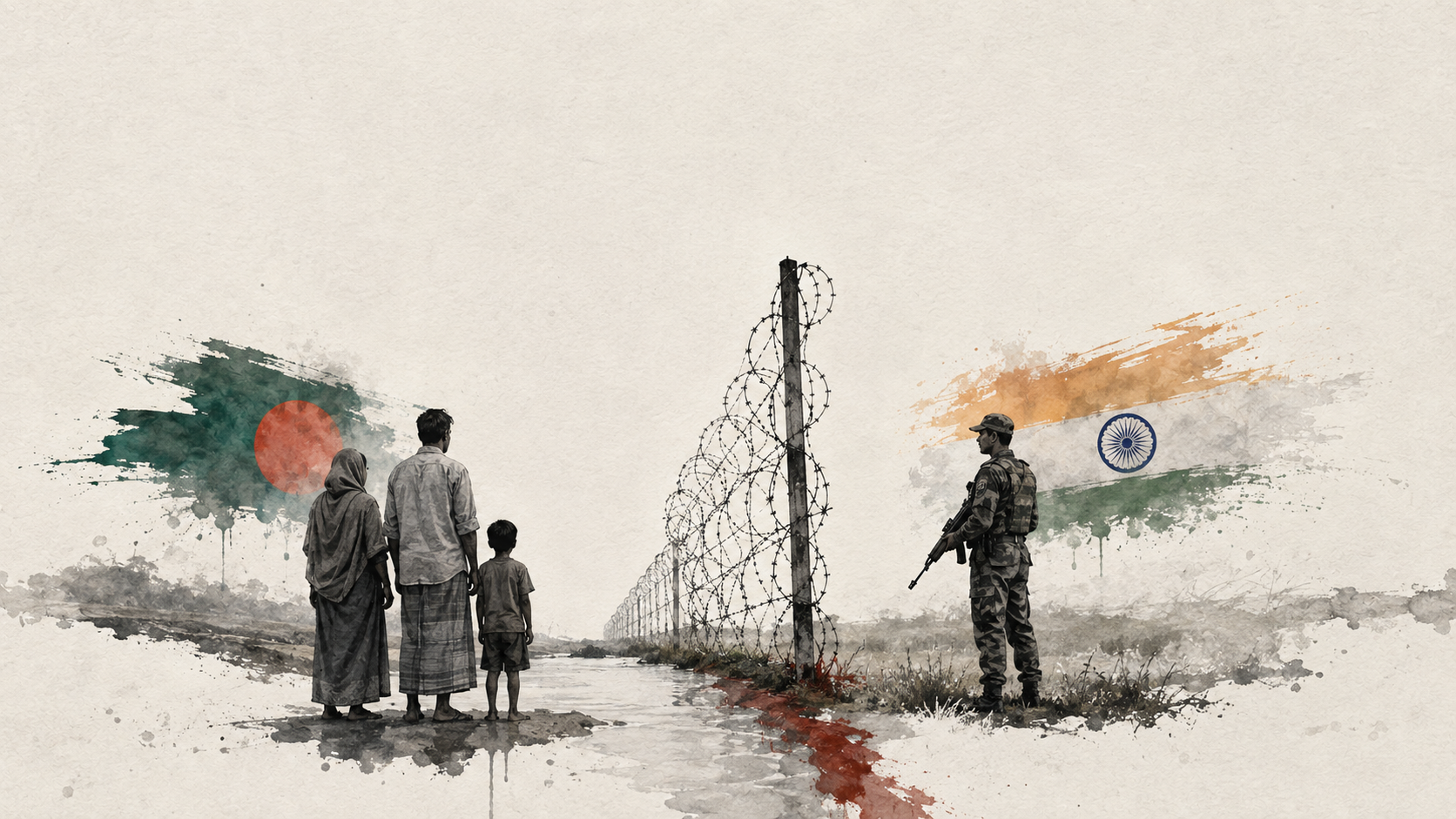
The escalating expulsions of Bengali-speaking minorities across the India-Bangladesh border have transformed a chronic migration dispute into an acute humanitarian and diplomatic emergency. Driven by domestic electoral politics, India’s shift from legal deportation to extrajudicial “push-ins” threatens to unravel bilateral relations just as critical resource treaties approach expiration. To prevent a future regional crisis, both nations must immediately replace unilateral force with transparent, institutionalized verification protocols.
From the shores of the Mediterranean to the banks of the Rio Grande, international borders are increasingly being weaponized as sites of political theater and humanitarian exclusion. Yet one of the world’s most volatile and legally dubious border crises is currently unfolding largely outside the global spotlight. Along the 4,096.7-kilometer boundary separating India and Bangladesh, a pattern of extrajudicial expulsions—described by New Delhi as “pushbacks” but more accurately called “push-ins” by Dhaka—is tearing families apart and destabilizing one of South Asia’s most important bilateral relationships. In mid-2026, this friction is no longer a routine border-management dispute. It is a crisis of due process, driven by the dangerous intersection of ethno-nationalist politics, militarized enforcement and weak bilateral verification.
The immediate catalyst is not a sudden, unprecedented wave of cross-border migration. It is a shift in India’s internal political and administrative machinery. For decades, both governments have formally accepted that verified foreign nationals should be returned through established channels. Recent developments, however, suggest a move away from court-supervised deportation toward unilateral administrative expulsion. India’s Immigration and Foreigners Act, 2025 consolidated central authority over the entry, exit, registration and regulation of foreigners. In practice, this has coincided with a more aggressive political environment in border states. According to BGB headquarters records cited by The Daily Star, at least 2,303 people were pushed into Bangladesh between May 7, 2025, and January 26, 2026. The same report said the group included 126 Indian nationals and 38 Myanmar nationals, showing how imprecise and dangerous such operations can become.
This erosion of due process disproportionately affects specific ethnic and religious communities. In India, the narrative of “illegal infiltration” has often been weaponized against Bengali-speaking Muslims, who are treated as suspects because of language, religion, class, and geography. The problem is not limited to one state. When Assam completed its Supreme Court-monitored National Register of Citizens in 2019, official NRC data showed that more than 1.9 million people were excluded. The result did not fit the simple political narrative that “foreigners” could be identified through religious identity alone. Many of those affected came from a range of communities, including Bengali Hindus, Bengali Muslims, Assamese Hindus, Gorkhas and others whose lives did not fit neat nationalist categories.
The political rhetoric, however, has remained blunt. In West Bengal, the BJP’s “Detect, Delete, Deport” slogan has turned citizenship and migration into electoral theater. Human Rights Watch reported in June 2026 that Indian authorities were forcibly expelling ethnic Bengali residents, mostly Muslims from West Bengal, to Bangladesh without basic due process. The report also cited West Bengal Chief Minister Suvendu Adhikari as saying that his government had detained hundreds of “Bangladeshi infiltrators” and forced nearly 5,000 people “to go back.” In Assam, Chief Minister Himanta Biswa Sarma has openly defended the practice of taking people near the border and pushing them across. Such statements blur the line between state policy and political spectacle.
The human toll is stark. Families are being turned into stateless pawns trapped in a heavily militarized zero line. In early June 2026, HRW reported that Bangladeshi border guards had foiled 21 attempts by the BSF to push more than 200 people, including children, into Bangladesh since June 1. Bangladeshi reporting later said the number of foiled attempts had risen further. In Panchagarh, witnesses described a 75-hour standoff after the BSF allegedly tried to push 10 people, including children, into Bangladesh. The group was reportedly stranded through rain and lightning while repeated flag meetings failed to resolve the crisis.
The violence accompanying the border crisis is equally alarming. According to Ain o Salish Kendra figures reported by Dhaka Tribune, 34 Bangladeshis were killed by the BSF in 2025, with 24 killed by shooting and 10 allegedly dying after physical torture. The same reporting said border violence remained a persistent pattern over the previous decade. On June 12, 2026, shortly after the 57th BGB-BSF director-general conference in New Delhi concluded with pledges of peace and stability, a Bangladeshi youth, Mujib Ali, was shot dead along the Moulvibazar border, according to BGB. Indian-linked reports framed the incident as a confrontation involving alleged smugglers. Even if such claims are contested, the timing exposed the widening gap between diplomatic language and border reality.
India’s current approach is not only a human rights concern. It is also a strategic miscalculation. The economic premise behind the “mass infiltration” narrative is increasingly outdated. Bangladesh is no longer the impoverished country imagined in older political discourse. In 2024, World Bank data put Bangladesh’s nominal GDP per capita at about $2,593, broadly comparable with India’s level. Cross-border movement, where it occurs, is shaped not only by poverty but also by labour demand in India’s construction, agriculture, domestic work and informal sectors. Indian employers benefit from vulnerable migrant labour, while politicians later denounce the same workers as an existential security threat.
The policy also weakens India’s moral standing abroad. New Delhi rightly demands consular access, fair procedures and humane treatment when Indian citizens are detained or deported overseas. But when people alleged to be Indian citizens are stripped of documents, transported to the border and forced into Bangladesh before nationality is properly tested, India undermines the very principles it invokes for its own diaspora. A country that seeks greater global leadership cannot afford to normalize legal shortcuts at its own frontier.
For Bangladesh, the push-in crisis compounds an already enormous humanitarian burden. Dhaka hosts more than one million Rohingya refugees in Cox’s Bazar, according to UNHCR, most of them denied citizenship in Myanmar and dependent on international assistance. Bangladesh therefore understands how opaque verification processes can generate long-term statelessness. It has legitimate reasons to refuse unilateral expulsions. At the same time, if some individuals are verified Bangladeshi nationals, Dhaka should accept them through formal repatriation procedures. The key is verification, not coercion.
The diplomatic fallout could spill into much larger issues. The 1996 Ganges Water Sharing Treaty, signed for 30 years, is due to expire in December 2026. Renewal talks are already difficult because of dry-season flow concerns, climate stress and competing water needs. A relationship defined by border standoffs, shootings and the abandonment of vulnerable families in no-man’s land creates a toxic environment for water diplomacy. Trust is the currency of bilateral negotiation, and at the zero line that currency is being depleted.
To avert a deeper regional crisis, both governments must act quickly. India should suspend unilateral push-ins and return to legally established consular verification. Bangladesh should cooperate in time-bound identity checks where evidence supports nationality claims. Both sides should create a joint verification mechanism using existing identity databases, including India’s Aadhaar infrastructure and Bangladesh’s national ID system, while ensuring that no person is expelled without written notice, legal representation and a right to appeal. Children, pregnant women, elderly people and asylum seekers should never be stranded between two armed border forces. Where citizenship or protection status is genuinely contested, neutral technical support from UNHCR or the International Organization for Migration could help make the process credible.
The families shivering under monsoon rains at the zero line are not abstract statistics or convenient political talking points. They are human beings caught between two neighbors that have previously resolved complex territorial and maritime disputes through patient diplomacy. True regional leadership requires more than fences, slogans, and force. It requires the discipline to enforce law through procedure. Until India and Bangladesh replace unilateral expulsion with institutional verification, the border will remain a bleeding wound in South Asia’s political geography.
Md. Saiful Islam Shanto is a Research Assistant at the Centre for Governance Studies (CGS).
Views in this article are author’s own and do not necessarily reflect CGS policy.