
South Asia's New Reality: Development Is Rising, Stability Is Not
Rahim Miah | 01 August 2026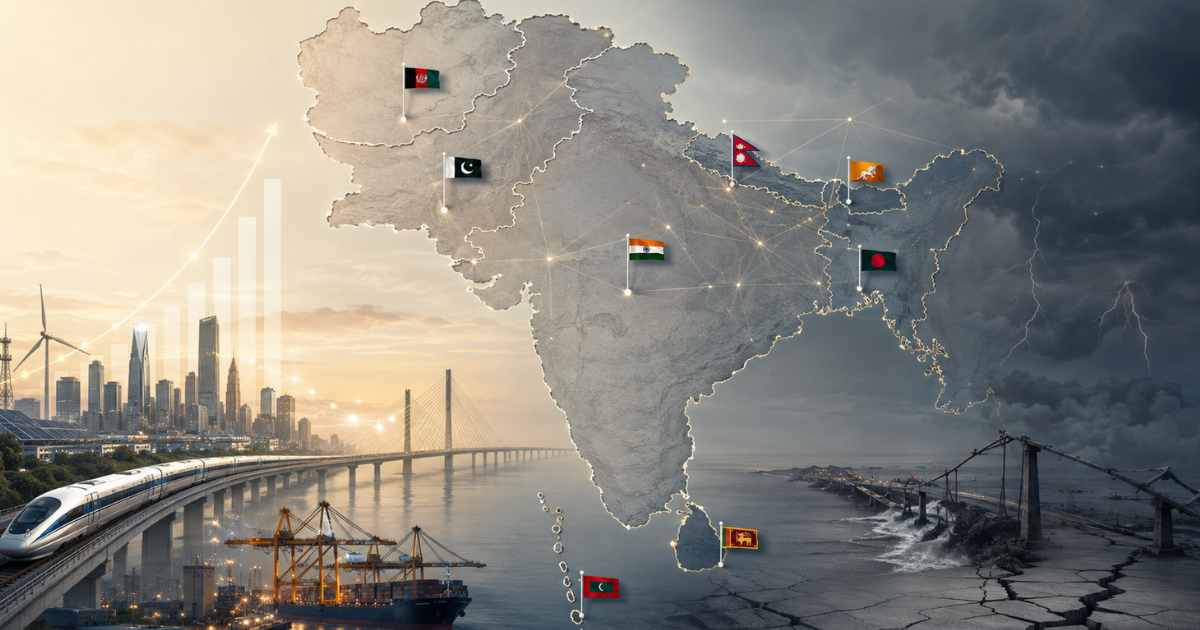
South Asia is developing faster than it is learning to keep the peace. Economies are expanding, cities are modernising, and digital connectivity is reshaping daily life across the region. Yet political trust remains thin, institutions remain fragile, and regional security remains unsettled. The region is advancing. It has not yet become stable.
This condition is not new. For decades, South Asia has cycled through competition and uncertainty, with the India-Pakistan rivalry shaping much of the subcontinent's strategic outlook. But the region's troubles extend well beyond that one rivalry. Weak regional cooperation, low institutional trust, and a persistent inability to convert shared challenges into joint solutions define South Asia as a whole. Even when confronted with common threats, states tend to respond alone, defensively, and belatedly.
This pattern is especially dangerous in a region where crises rarely stay contained. A border skirmish, a political shock, a dispute over shared rivers, or a shift in an external power's posture can spread quickly across borders. In South Asia, insecurity is contagious. Even minor incidents can acquire outsized strategic weight when trust is absent. The region's task, then, is not simply to prevent conflict. It is to build a political culture resilient enough to absorb pressure without sliding into confrontation.
A significant shift is underway in how the region understands security. Climate risk has become a security concern in its own right. Floods, cyclones, droughts, heatwaves, riverbank erosion, and rising sea levels are placing sustained pressure on food systems, livelihoods, migration patterns, and government capacity to respond.
In Bangladesh, India, Pakistan, Nepal, Sri Lanka, and Afghanistan, climate change already shapes daily political and economic life. It is not a distant, hypothetical risk. Environmental stress is driving rural-to-urban migration, straining already overcrowded cities, worsening public health outcomes, and fuelling tension over shared resources. As water grows less predictable and land more vulnerable, governments face a stark choice. They can invest in preparedness now, or manage disaster and instability later.
Demography is another defining feature of the region. South Asia's young population is a genuine asset, full of energy and ideas capable of transforming the region's economic and social trajectory. But that potential is conditional. Governments must give young people the education, employment, and civic voice that allow them to participate meaningfully in national life.
When young people lack jobs, skills training, or a say in how their countries are run, the consequences extend beyond individual hardship. Youth exclusion carries real political costs. When young people conclude that they will not be respected, they respond by protesting, emigrating, or disengaging from civic life altogether. South Asian governments frequently describe their youthful populations as a demographic dividend, but that dividend materialises only where governments invest sustained time and resources in the young. Absent that investment, the same demographic weight becomes a source of instability rather than strength.
South Asia retains the institutional architecture of democracy: elections, parliaments, constitutions, and political parties. But these institutions often function in form more than in substance. Elections are held, though not always through fair competition. Constitutions exist, though those in power do not always abide by them. Parliaments convene, though public trust in them remains low. The result resembles democracy without consistently functioning as one.
This gap becomes visible in how citizens are treated across the region. Freedom of expression is inconsistent. Minority protections are uneven. Judicial independence is often compromised. Women's safety cannot be taken for granted. Media freedom is constrained in many places. A government that fears its own citizens is, by definition, a weak government. These accumulated rights deficits erode legitimacy, and without legitimacy, sustained growth and stability are difficult to sustain.
South Asia talks about regional cooperation considerably more than it practices it. Neighbouring countries trade with each other far less than their proximity and complementary economies would suggest. Mutual distrust routinely delays connectivity projects and stalls collaboration on energy. SAARC, conceived as a platform for regional collaboration, has struggled to remain relevant. The result is a region that repeatedly forfeits opportunities that would benefit all its members.
This is a costly mistake. Regional cooperation is not only about trade; it is also about collective strength. Improved trade, transport, energy, and digital connectivity would make South Asian states more interdependent, and, somewhat paradoxically, more resilient as a result. Joint infrastructure projects can even help build trust between states that otherwise distrust one another. South Asia has enough shared history and geography to make integration work. What it lacks is leadership willing to make integration a genuine priority.
Great power competition is increasingly shaping the region's choices. The United States, China, India, and Russia are each pursuing their own objectives in South Asia through infrastructure investment, security partnerships, trade, and technology transfer. This dynamic offers South Asian states both opportunities and risks. Engagement with major powers can bring financing and expanded options, but it can also produce excessive dependence and deepen internal divisions.
The central challenge is strategic autonomy. South Asian states need to engage major powers without becoming dependent on them. That requires clear national priorities, disciplined strategy, and stronger domestic institutions. States that are internally unstable are more vulnerable to being drawn into external rivalries, while politically cohesive states are better positioned to turn great power competition to their own advantage. Preparedness, not luck, makes the difference.
South Asia now faces a choice. It can continue treating rivalry as normal and instability as inevitable, or it can begin building the confidence, habits, and institutions that a more stable future requires. The first path leads to recurring crises, squandered potential, and heightened vulnerability to both internal and external shocks. The second path is harder and slower, but far more sustainable.
South Asia does not need to eliminate competition. It needs to manage competition without letting it crowd out cooperation. The region does not need perfect balance. It needs trust. It does not need sweeping change overnight. It needs to recognise that growth without stability is insufficient, and that stability without cooperation is temporary. The region's future will not be settled by any single summit, election, or crisis. It will be determined by whether South Asia's leaders can set aside rivalry long enough to confront the challenges ahead. South Asia can no longer afford to wait.
Rahim Miah is a student pursuing his undergraduate degree in International Relations at Jahangirnagar University.
Views in this article are author’s own and do not necessarily reflect CGS policy.