
Beijing Summit Signals a G-2 World
Roman Uddin | 20 May 2026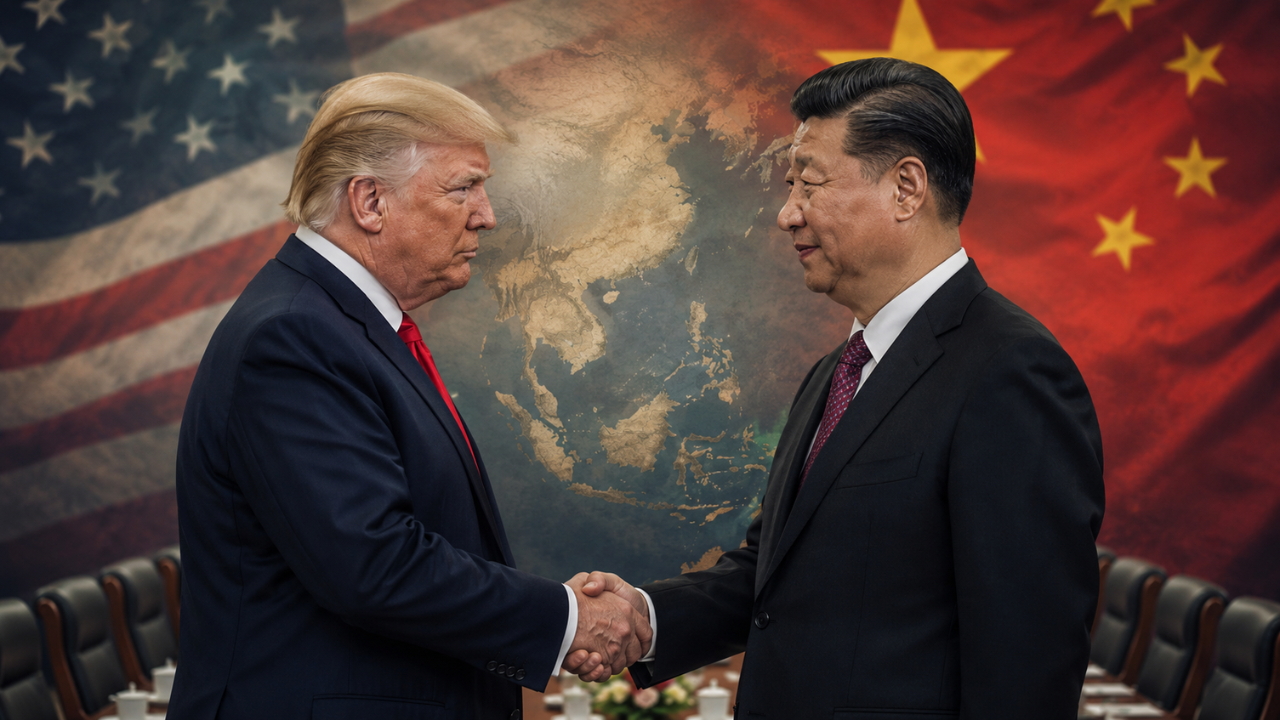
The May 14-15 meeting between Donald Trump and Xi Jinping in Beijing should not be remembered only as another high-level diplomatic encounter. It was not a clean reset in U.S.-China relations. It was something more revealing, a rehearsal for a world in which Washington and Beijing may try to manage global affairs between themselves while the rest of the world adjusts to their bargains and rivalries.
The atmosphere in Beijing was carefully designed. Xi received Trump with the full weight of Chinese state ceremony. The setting, the language and the optics all suggested parity. For China, that mattered. Beijing has long wanted the United States to treat it not as a challenger to be contained, but as an equal power whose interests must be accommodated. In that sense, the summit gave Xi something valuable before any agreement was signed: the image of China standing level with the United States.
Trump also seemed comfortable with that image. His language around a possible G-2, meaning the United States and China as the two central powers of the global system, may sound practical to some. The two countries dominate trade, technology, manufacturing, finance, military planning and climate diplomacy. If they talk, tensions may ease. If they stop talking, the world becomes more dangerous.
But this is where the problem begins. A G-2 world can offer stability, but it can also shrink the space for everyone else. Smaller and middle powers do not want a war between Washington and Beijing. Yet they also do not want a private arrangement in which their security, markets, supply chains and diplomatic choices become bargaining chips.
That is why the Beijing summit matters beyond the headlines. It did not deliver a grand bargain. It did not solve the technology war, the tariff dispute, the rare earths problem, the Taiwan question or the conflict around Iran. Some limited economic understandings emerged, including a framework for tariff reductions on selected non-sensitive goods and a Chinese purchase commitment involving Boeing aircraft. But the larger disputes remained in place. Advanced chips, export controls, critical minerals and strategic distrust were not resolved by ceremony.
The Taiwan issue showed the limits of warmth most clearly. Xi warned that mishandling Taiwan could lead to serious conflict. Trump avoided giving a firm public commitment either way. That ambiguity may be useful for diplomacy, but it is unsettling for Taipei and for the wider Indo-Pacific. If Taiwan becomes part of a larger U.S.-China management formula, the danger is not only conflict. The danger is also miscalculation born from unclear signals.
This is the real lesson of the summit, great powers often call it stability when they are really negotiating the terms of rivalry. China’s preferred language after the meeting, “constructive strategic stability,” sounds calmer than “strategic competition.” But the phrase should be examined carefully. Stability for whom? Constructive for whom? If stability means fewer accidents at sea, better military communication and more predictable trade rules, the world should welcome it. But if it means accepting spheres of influence, pressure on smaller states and silence on hard questions, then it becomes a different kind of risk.
The current world is already moving in that direction. Globalization has not ended, but it has become more political. Supply chains are being redesigned around security, not only efficiency. Semiconductor rules are treated as national security tools. Rare earths are no longer just industrial inputs. Shipping lanes, ports, data centers, energy routes and undersea cables are now strategic assets. In this environment, every U.S.-China meeting sends signals far beyond the two capitals.
For countries in Asia, Africa, Latin America and the Middle East, the message is complicated. They need Chinese investment, American markets, Western technology, Gulf energy, multilateral finance and strategic flexibility. They cannot afford to choose one camp permanently. Bangladesh, India, Indonesia, Vietnam, Saudi Arabia, Brazil and many others are trying to preserve room for maneuver. A G-2 mindset threatens that room, because it assumes the world’s most important questions can be settled by the world’s two most powerful capitals.
This is why the summit should worry even those who support dialogue. Dialogue is necessary. U.S.-China military communication is necessary. Trade talks are necessary. Cooperation on AI safety, energy security and global finance is necessary. But dialogue becomes dangerous when it turns into hierarchy. The world needs U.S.-China engagement, not U.S.-China supervision.
That makes the coming years more fragile, not less. If the United States and China compete without rules, the world faces confrontation. If they cooperate only to divide influence, the world faces exclusion. The better alternative is a broader order where other powers, regional institutions and smaller states have a voice in shaping rules on trade, technology, climate, security and finance.
The Beijing summit was therefore not a reset. It was a preview. It showed how the twenty-first century may be governed if other countries remain passive: two giants managing tension, trading concessions and defining stability in their own image. The rest of the world should not reject U.S.-China dialogue. But it should reject the idea that peace is safest when power is concentrated in two hands.
The real question after Beijing is not whether Trump or Xi won. The question is whether the world is prepared to live inside a G-2 arrangement, or whether it still has the imagination and courage to build something wider, fairer and more durable.
Roman Uddin is a Research Associate at the Centre for Governance Studies (CGS).
Views expressed in this article are the author’s own.