
Hindutva’s Main Challenger was Federal State Identity. Has The Fall of TMC and DMK Ended That?
The India Fix: A newsletter on Indian politics from Scroll.
Shoaib Daniyal | 06 May 2026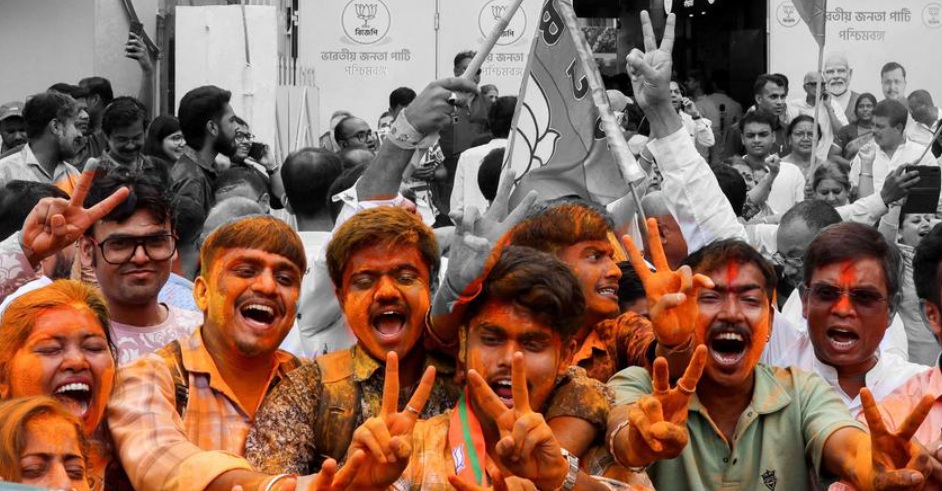
Welcome to The India Fix by Shoaib Daniyal. A newsletter on Indian politics.
As always, if you’ve been sent this newsletter and like it, to get it in your inbox every week, sign up here (click on “follow”).
Till the 1980s, it was difficult to imagine a Hindutva party in power, given the importance of secularism in Indian political life. But over the past four decades, the Bharatiya Janata Party has worked assiduously to wipe out this ideology.
Given the election results on Monday, something similar can now be seen to be happening with federalism.
In West Bengal, the BJP has, at the time of writing, taken a significant lead over the Trinamool Congress, a party that identifies with Bengali nationalism. And while the Hindutva party is not a major player in Tamil Nadu, it would be chuffed that the DravidaMunnetraKazhagam has seen crushing defeat. More than any other force, the DMK is the progenitor of federalism and state-based linguistic identity in India.
A new foe
After the demise of secularism in the 1990s and 2000s, federalism became the BJP’s main bugbear.
Part of the reason was electoral. For much of the Modi era, even as the BJP has been unchallenged at the Union level, it has faced far more difficulties at the state level. An analysis I did from 2018 to 2020 showed that the BJP’s vote share fell sharply in state elections compared to the 2019 Lok Sabha elections. Clearly, Modi as a vote getter performed much better on a national stage than in the states.
But the states were more than just electoral challengers for the BJP – they birthed the party’s main ideological opposition in the Modi age. For the past decade or so, with secularism nearly dead, state identity has been Hindutva’s main ideological opponent.
Bengal has been the principal arena of this battle. When it was founded in 1998, the Trinamool had little fidelity to any ideology, much less Bengali nationalism. It only adopted it in a big way in the run-up to the 2021 Assembly elections. As the BJP’s star rose rapidly in the state, the Trinamool used Bengali nationalism as a weapon to push back against the force of Hindutva. Though the Trinamool’s adoption of Bengali nationalism was late and never very whole-hearted, it helped the party defeat a strong challenge from the BJP in 2021.
While the BJP felt confident enough to take secularism head-on ideologically, it never did so with Bengali nationalism. Instead, its main tactic in the current election was to try and convince Bengalis that their identity would not be challenged. Photos of BJP candidates campaigning with dead fish as a way to reassure Bengalis that their way of life would continue unmolested was the most comic image of this election.
Nevertheless, the BJP’s adoption of Bengali identity is almost certainly tactical and were it to form a government in the state, it is highly likely it would principally rule using the strategies and goals of its founding ideology, Hindutva.
Ideological hegemony
In Tamil Nadu, meanwhile, the DMK’s defeat is a massive setback for Dravidian politics. This ideology’s principal feature was to oppose the hegemony of North India as well as the Hindi language. The BJP’s ideological championing of Hindi as well as its roots in the Hindi belt meant that the Hindutva party was the DMK’s principal ideological opponent in spite of the fact that it was a minor player in the state.
The defeat of the DMK, much like the defeat of the Left in Bengal in 2011, does not directly open space for the BJP – but the ideological vacuum it would create could theoretically allow the party and its Hindutva ideology room to grow. Like the Trinamool, which took power in 2011, the TamilagaVettriKazhagam, the party leading right now in Tamil Nadu has no strong ideological moorings – making conditions even better for Hindutva, given it will face little opposition.
The BJP is a sharply ideological party. The only way to defeat it is to launch an ideological counter. But with the demise of federalist state identity, it seems Hindutva has near-total ideological hegemony for the immediate future.
Shoaib Daniyal is a Scroll.in staffer.
This article was originally published on Scroll.in.
Views in this article are author’s own and do not necessarily reflect CGS policy.