
A Route of Death Not Dreams
Jahanara Jaba | 08 April 2026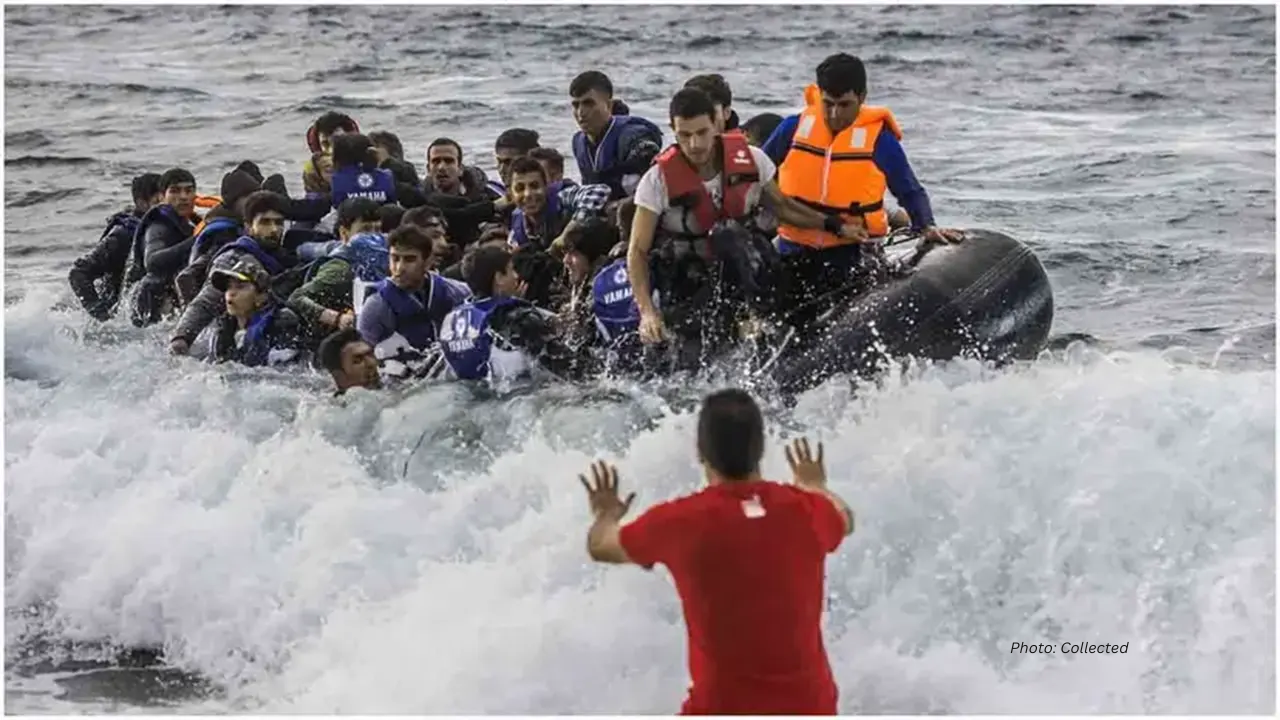
The boat drifted with twenty-two without having a drop of water. The recent tragedy off the coast of Greece, where at least 22 migrants died after drifting at sea for six days without food or water, should finally force a change in how this route is understood. Among those rescued alive were 21 Bangladeshis. Survivors said that the bodies of those who died were thrown into the sea during the journey. This was not simply a maritime accident. It was the visible outcome of a system in which human beings are exposed to danger from the moment they are recruited until the moment they disappear into the water.
Bangladesh has over the years referred to this path as illegal migration. Such a word is too limited to understand the consequences. What is happening is not merely unauthorized border crossing. It is a structured trafficking economy.That’s clearly crime. It begins with false promises at home, moves through detention and extortion in Libya, and often ends either in the Mediterranean or in detention centers This means this is not a fraud that is a single instance. It is a multi-stage system of exploitation.
How does this route work? It works because it follows a recognizable structure. The first stage is recruitment where the local brokers would sell a known tale: My son is already there, Italy can be reached cheaply, legal status will come quickly, work is ready, and income will begin within months. For families already under economic and social pressure, this does not sound like speculation; it sounds like escape. The second stage is financial commitment. Land is sold, loans are taken, jewelry is mortgaged. Once that investment is made, withdrawing becomes far more difficult. The third stage is transit. Migrants are moved out of Bangladesh, often through intermediary points, before being taken to Libya. There, the route shifts from migration to coercion. Instead of work, they face confinement, threats, beatings, and repeated demands for more money. Then comes the final stage, what many migrants and smugglers call the game, the Mediterranean crossing itself, where reaching Italy is treated as success and detention, disappearance, or death as the risk of failure. By that point, the migrant is no longer treated as a worker in transit, but as a body to be moved onward for profit.
Why do people still take this route? It cannot be entirely attributed to poverty alone. The decision emerges from a combination of pressure at home, aspiration abroad, and the weakness of credible alternatives. On the push side are economic insecurity, underemployment, stagnant or low wages, debt, and the pressure of supporting families in a context where social mobility often feels limited. For many young men, the problem is not only that they are poor, but that they see no convincing path to improve their lives within a reasonable time. Migration, in that context, appears less like adventure than like necessity. On the pull side are the visible success stories of those who have made it to Italy. Families see remittances, new houses, improved social standing, and the symbolic prestige that migration can bring. What they do not see with the same clarity are the detention centers, ransom demands, failed crossings, missing bodies, and long periods of irregularity. This imbalance matters. Success is public; failure is often hidden by shame, fear, or silence. Added to this is distrust in legal migration pathways, which many families perceive as slow, expensive, opaque, and inaccessible. In that gap between pressure and aspiration, the trafficker’s promise begins to look plausible. The broker’s power lies not merely in deception, but in the ability to present an illegal route as the only practical route when legal ones seem remote or unattainable. In that sense, people do not take this route simply because they underestimate the danger. Many take it because the uncertainty of staying feels, to them, more immediate than the risks of leaving.
These are well known consequences. In the first six months of 2025 alone, 9,735 Bangladeshis reportedly attempted to enter Italy by crossing the Mediterranean. During the same period, 718 migrants were reported missing or dead in the Central Mediterranean, including 701 who drowned. Twelve percent of those who died on this route were Bangladeshis. This is not a marginal statistic. It is a stark indication that Bangladesh has become a visible source country in one of the world’s deadliest migration corridors.
Even those who survive do not return with stories of opportunity. Accounts from Bangladeshi returnees from Libya show that many never found the promised jobs. Instead, many experienced detention, abuse, restrictions on movement, and severe deprivation. This makes clear that the Libya route is not a pathway into the labor market. It is a system of organized coercion. Yet people continue to leave because, for many, the uncertainty of staying home appears even more unbearable than the dangers ahead.
This is where the state’s responsibility becomes central. Human trafficking is not the kind of crime a government can afford to address only after bodies appear or families file complaints. A functioning state is expected to identify patterns, map networks, investigate financial flows, and act before young men vanish into foreign camps or the sea. Yet the repeated pattern in Bangladesh has been delayed reaction rather than prevention. That is not merely a failure of enforcement. It is a failure of priority.
But an even harder question must be asked: is the government actually willing to dismantle this system, and even if it is, does it have the capacity to do so? Willingness matters because breaking this network means confronting local brokers, money intermediaries, cross-border trafficking routes, and the institutional complacency that allows the system to function. Without political will, laws remain symbolic. Capacity matters because this is not a simple domestic law-and-order problem. It is a transnational crisis involving Libya, Mediterranean crossings, repatriation, rehabilitation, financial investigation, intelligence coordination, and the creation of credible legal alternatives. Bangladesh has some of these capacities in fragments. What it has not yet demonstrated is a sufficiently coordinated, prioritized, and sustained response.
It must also be acknowledged that trafficking cannot be stopped by arrests alone. As long as legal migration pathways remain too slow, too costly, too opaque, and too inaccessible for ordinary people, the market for illegal routes will survive. When safe options are weak, dangerous options gain value. Any serious strategy must therefore go beyond cracking down on traffickers. It must also make legal migration more transparent, affordable, and trustworthy. Otherwise, one group will be repatriated while another is pushed toward the same sea.
Society, too, has a role in sustaining this crisis. Migration continues to occupy a powerful place in the social imagination as a shortcut to dignity and upward mobility. The success stories circulate widely. The stories of detention, debt, humiliation, and trauma usually do not. That uneven visibility helps the trafficking economy reproduce itself. So, this is not only an administrative crisis. It is also a social one. Until failure and suffering become as visible as success, the demand driving this route will remain intact.
In the end, the issue is not the route or way of achieving success. The Mediterranean does not call people to it. People are pushed there by unemployment, insecurity, social pressure, blocked legal pathways, criminal deception, and prolonged state inaction. That is why everyovercrowded boat drifting near Greece is more than a migrant tragedy. It is also a reflection of Bangladesh’s policy failures, weak governance, and neglected citizens. Calling this route a dream is not only misleading. It is dangerous. It is, in truth, a route of exploitation, and too often, a route to death.
• Jahanara Jaba is a Research Intern at Centre for Governance Studies (CGS)
Disclaimer: Views in this article are author’s own and do not necessarily reflect CGS policy