
Fear and Loathing Greet Myanmar’s Unfree Election
Ben Dunant | 14 January 2026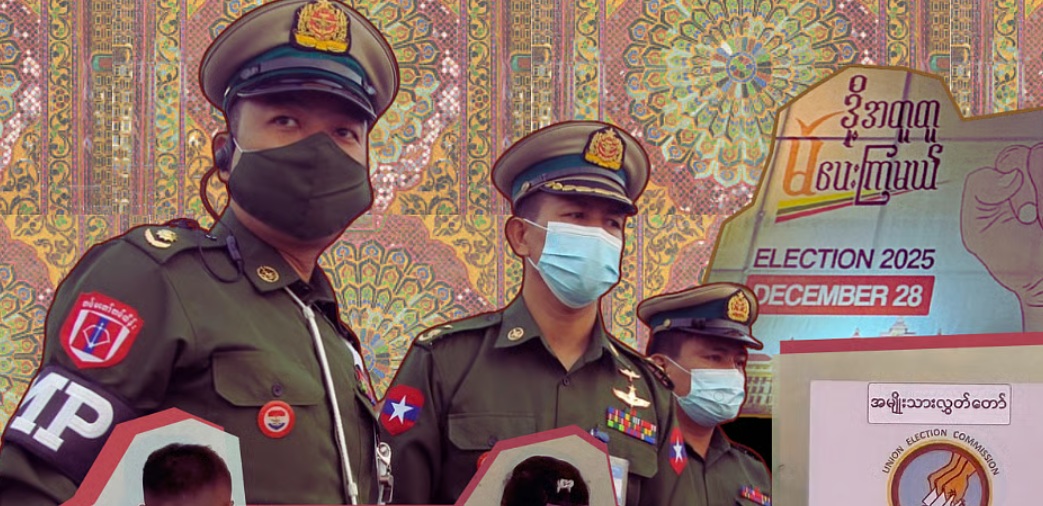
Ground reporting of the 2025-26 election reveals that voters only hope for a slight lifting of the military’s boot in a race with virtually no political opposition
WE FOUND THE NEIGHBOURHOOD sleeping under pale streetlamps and a half moon. A lone old man shuffled past on a 5am errand and pointed the way to the school, where voting was soon to begin.
Inside the dark compound, my Burmese colleague and I found a brightly lit classroom where polling staff were arranging tables, cardboard booths and electronic voting machines. They were mostly female teachers, joined by other junior government staff. When dawn came, so did two soldiers and an armed policeman, taking chairs 50 metres away.
The polling staff made nervous jokes as they primed the voting machines, whose heft and chunky buttons recalled a long-dead gadget from the 1970s. They then fastened seals on adjoining plastic boxes, where printed ballot receipts were to tumble unseen, and prepared pots of indelible ink to mark the fingers of voters.
The machines were new, and had been introduced with little transparency, but the seals and inkpots recalled similar safeguarding rituals from previous votes in 2015 and 2020. These elections were democratic milestones for Myanmar, resulting in landslide wins for the National League for Democracy (NLD) led by the dissident icon Aung San Suu Kyi. But here the rituals were in service of something entirely different. This election, which began on 28 December, with two subsequent phases of voting on 11 and 25 January, is at heart a coronation.
The country’s military junta has purged its only serious rival, the NLD, from politics after toppling its administration and jailing its leaders in a 2021 coup. Meanwhile, most of the other parties that did well in 2020 have refused to register under draconian post-coup regulations. This has left no party capable of challenging the military’s proxy, the Union Solidarity and Development Party (USDP), beyond carving out an impotent minority in parliament.
After the election, the new parliament will choose the president, who is widely expected to be the current junta chief, Senior General Min Aung Hlaing. Besides an assumed USDP majority, his anointment will also be eased by an article of Myanmar’s 2008 constitution, drafted by a previous junta. This article automatically grants a quarter of parliamentary seats to unelected members of the military, who will be even more loyal to the commander-in-chief.
The true safeguards for the military in this election are, therefore, political. They are not to be found at the polling station, but in all that the military has done to re-engineer politics beforehand, preserving its dominance in perpetuity.
This is perhaps why the junta took the rare step of allowing journalists in for the election. Foreign reporters like me, they may have hoped, would fixate on the relative order of the polling stations while ignoring the wider context or what ordinary people had to say.
However, little could be done to hide the sparse voter turnout at most of the polling stations in Myanmar’s biggest city, Yangon. In 2015 and 2020, when the NLD was on the ballot, people formed snaking queues long before voting opened at 6 am, even though they had 10 more hours to vote. They were eager to exercise a right denied to them during previous decades of military rule. The mother of a local friend of mine hauled herself from her sickbed to vote in 2020, while the Covid-19 pandemic raged. Afterwards, she collapsed and was admitted to hospital.
This time, the pre-dawn queues were replaced by a trickle of typically elderly voters. Most passed swiftly through the polling stations, but some were unable to find themselves on the voter list or complained of inaccurate personal details. “I’m going home!” shouted one middle-aged man whose registration had been botched. Another man was only able to vote after a local official was fetched to verify his residency in the neighbourhood.
There was a rich irony to these mishaps. The military had overturned the results of the 2020 election, with its NLD landslide, while alleging massive errors in the voter list. The current list was compiled with the help of a household census that, by the junta’s own admission, had missed an estimated 19 million out of 51 million people due to conflict. After the coup, protesters took up arms and allied with an array of veteran ethnic armed groups that have struggled for autonomy against the military for decades. Combine this expanded war with a general gutting of administrative capacity, and there was little reason to expect a better voter roll.
Nonetheless, inclusion in the list was enough to make some turn out – generally out of fear rather than enthusiasm. This was particularly the case in poor neighbourhoods on the fringes of Yangon or in the countryside beyond. In the rural town of Twante, residents said they had little desire to vote but feared punishment for abstaining. A few mentioned direct pressure from authorities, corroborating widespread media reports of intimidation, but most said they were worried by rumours – including that they could be barred from travelling overseas if they did not participate.
A 34-year-old fish farm worker, from a village near Twante, said his family had insisted he vote out of fear he could be conscripted into the military for refusing. The military in early 2024 launched a nationwide conscription campaign, estimated to have forced up to 100,000 men into its ranks and prompted thousands more to flee the country. The man said his family was paying a bribe each month to exempt him from the draft.
Not everyone was convinced of the rumours, but voting was ultimately a small task to ward off any potential threats. It was better to stay safe, given the regime and its underlings were capable of any type of injustice.
After the coup, the junta rolled back most of the freedoms granted in the preceding decade, but it tightened the screws further in preparation for the election. The regime has charged more than 300 people under a new “election protection law”, some in absentia. The charges cover even Facebook posts critical of the polls, as well as people “liking” these posts, alongside other peaceful forms of protest. In September, three people were given prison sentences of between 42 and 49 years for putting up posters in Yangon calling for an election boycott.
In this environment, mere requests from local authorities carry the weight of orders. Defiance could be dangerous.
Employers, caught in the middle, have contributed to the pressure. The river jetties of Twante were busy with workers from Yangon factories on the day before voting began. Their bosses had granted them leave and told them to return to their villages, reached via long-tail boat from Twante, to vote. One young worker, waiting for a boat at a teashop, said she had little idea about the candidates or parties, or even whether she was properly registered to vote. Nonetheless, she would do as expected.
A nearby roadside vendor said he would just pick random candidates, but he was eager to ensure polling officials ticked him off the voter list. “We have to vote. We live under them,” he explained. Others would also refer only to “them”, unwilling to mention the military by name.
Such caution in rural or peri-urban neighbourhoods, where authorities keep a closer watch, appeared to explain the vastly higher turnout on voting day as we went beyond the city. In a village school surrounded by parched rice fields in Thanlyin Township, a polling station was crammed with people even as the heat of noon approached.
At the gates sat a police officer and a rifle-bearing member of a local militia, one of hundreds raised to suppress armed resistance across Myanmar since the coup. Locals say these militia are often filled with neighbourhood thugs and petty criminals, who abuse people worse than regular soldiers. This is grim proof that military rule endures not only through control from the top but also by unleashing the cruelty and greed of those at the bottom – from village officials extorting bribes from the poor and powerless to disaffected young men handed a militia uniform and a license to bully their betters.
These security personnel were joined at the polling station by another bottom-feeder: a plainclothes member of Special Branch, the intelligence wing of the police force. He took numerous pictures of me and my documents, before tailing us closely within the school compound. As we tried to talk to polling officials, he scribbled notes and even answered questions on their behalf. It was far too risky to interview voters there; the spy was clearly watching them as well, to ensure they quietly fulfilled their duty to the state.
Resisting a coup
There was a different atmosphere back in the city, where many said they could ignore the vote without much risk. Yangon, at least in its more prosperous centre, has always been a place apart from the poor villages and dusty towns where most of the population lives. It is even more of an island now, with conflict spreading from the borderlands since the coup to engulf entire regions of the country. This has stunted the reach of the election, with voting cancelled in 65 of Myanmar’s 330 townships and large tracts of the countryside elsewhere.
Removed from the fighting, Yangon was in a holiday mood in late December. Young couples strolled the shores of Inya Lake while smartly dressed families circled the Shwedagon, the golden pagoda that forms the city’s sacred centre.
But the mood was easily punctured. Near the Shwedagon is a prayer hall sheltering families who have fled the war in Kachin, Myanmar’s northernmost state. There, a 53-year-old woman described how a bomb had destroyed her old home and killed her husband and daughter. Despite losing so much, she wanted only to return. Some at the shelter had found work repairing air-conditioners in the city or doing other casual jobs, but most simply waited, subsisting on monthly bags of rice from a local charity. The woman knew the election would not end the war or offer a path home.
Few people we spoke to in the city expected more than a slight easing of the military’s grip after the vote, let alone peace. But, for some, this offered a thin sliver of hope when there was no viable alternative.
Such alternatives remain in theory. The parallel National Unity Government (NUG), appointed by members of parliament deposed by the coup, still claims the mandate of the 2020 election, whose legitimacy the current vote can’t expect to match. The NUG operates largely in exile, but some of its senior members are sheltering in areas seized from the junta. At the same time, ethnic resistance groups say their substantial territories could form the foundations of a new federal Myanmar, with power devolved to minority groups. Several million people already live outside of the military’s administration, even if they can’t escape its blockades and airstrikes.
However, the military, backed by China, has bounced back and retaken a string of towns and major highways over the last year. It has also struck ceasefires with some of its stronger enemies, driving wedges into an already fragmented resistance. Meanwhile, it is Min Aung Hlaing, not the NUG, who is increasingly being embraced by regional leaders. The war will continue and may defy predictions, but the dreams of the post-coup protests, which demanded the military’s exit from politics, feel distant.
A writer and translator in Yangon, whose neighbourhood is earmarked for the second phase of the election, said he would vote because opportunities for change should be taken, however meagre they may be. He said he would choose candidates from the People’s Party, which touts peace and democracy but, lacking the appeal of the NLD, failed to win a seat in the 2020 election. He said he admired the party’s leader, the former student activist Ko Ko Gyi, who until 2012 had spent almost two decades in prison for opposing the military.
IN LATE DECEMBER, Ko Ko Gyi was holding court before the world’s media at his Yangon head office. As I entered the office, in a simple flat in a downtown high-rise, he mentioned that the New York Times had just left. It must have felt like a rare moment in the sun for the party leader. He had been vilified for opting out of the post-coup uprising, instead participating in the junta’s preparations for a new election after it cancelled the results of the 2020 vote.
Ko Ko Gyi said contesting the current election was “a tough decision” for his party, but defended it as the only way to stay relevant. “I know well about the situation,” he said, referring to the many political prisoners and people killed in the war. “The problem is how to find a solution. Whether we like it or not, we just try to be pragmatic.”
He believed the armed struggle against military rule was doomed by its internal divisions and lack of meaningful foreign support, contrasted with the backing the junta has received from China and other powers. “Myanmar cannot go beyond regional politics,” he said.
He also contrasted his “pragmatic way” with what he regarded as the ultimately empty, symbolic politics of the NUG and resistance leaders who operate largely abroad. “Outside politics is easy. There’s no need to be afraid and you can openly criticise the military.” But inside Myanmar, he said, “we can only be silent.” Seats in parliament could at least give the people a voice, he argued, describing his message to voters as: “If you’re afraid to say something, tell me, and I’ll say it on behalf of you.”
Sandar Min, an independent candidate and formerly a prominent member of the NLD, made a similar argument when I spoke to her in Yangon. “The people have had to be silent over the last five years,” she said, referring not only to the lack of free speech but also to the absence of any formal consultation by the regime with the public. “But at least we can raise our voices in parliament, and they can’t arrest us for that.”
Sandar Min, who is contesting a seat in Yangon in the second phase, said it was only “half true” that the election result was a foregone conclusion. She and Ko Ko Gyi both expected a majority for the USDP – which, after all, was fielding hundreds more candidates than any other party due to its superior reach and resources. However, they believed a vocal minority in parliament was worth fighting for. “If you don’t like people, don’t let them win,” was Sandar Min’s message to voters.
She was similarly dismissive of NUG leaders working in exile. “Politicians inside the country are more important than those outside,” she said, predicting that the latter would sink into obscurity.
Yet it was clear that Sandar Min and Ko Ko Gyi were only reaching for whatever breadcrumbs were left on the table once the military had its fill. Ko Ko Gyi played down any comparisons to the 2010 election – a military-run vote that also delivered a USDP majority but preceded a decade of dramatic reforms. He conceded that, this time, “We can’t expect too much … only the appearance of the separation of powers.”
It was little surprise, then, that the two politicians said they had struggled to interest voters. Other contestants confessed the same. Nai Than Shwe, a candidate and spokesperson for the Mon Unity Party, drawn from the Mon ethnic minority, said his party had to spend less time explaining its policies than persuading the Mon community to vote in the first place.
In addition, some contestants seemed to be on a tight leash. One high-profile candidate told me she had to check in each morning with a military intelligence minder. She was nervous about being interviewed by me and eyed the staff warily at the restaurant where we met, despite having picked the venue herself. She jumped when she received a call from an unknown number. It turned out it was only a friend, but she took several minutes to stop shaking before resuming our conversation.
THE HOPES of these candidates are also dimming as the results of the first phase of voting trickle in, indicating a USDP landslide. The party has taken more than 80 percent of the seats declared so far, with the rest won mostly by parties representing some of the country’s many ethnic minorities.
The USDP’s majority may be somewhat tempered by the mixed electoral system. For the first time, seats are split between first-past-the-post and proportional representation races. The second-ranking, and perhaps even the third-ranking, party in any constituency can expect to win some proportional representation seats, most of which reflect the cumulative vote from multiple phases. Still, the limited size and number of proportional representation constituencies – accounting for only half of seats in regional parliaments and in the union upper house, but none in the lower house – mean they won’t turn the tide.
Sandar Min said the military’s proxy party had been helped by the tepid voter turnout so far: 52 percent for phase one, according to the junta. She explained that the USDP could rely on the support of people connected to the military or government ministries, who were much more likely to vote, despite the party being unpopular with the broader public. She claimed that boycott calls from the NUG and other resistance groups had helped to suppress voter numbers. “The NUG has made the USDP win,” she said.
Ye Kyaw Swer, a People’s Party candidate who lost a Yangon seat to the USDP, also said turnout had decided the outcome. He added that votes for opposition parties like his were heavily split.
Besides these favourable results, the junta has also received high fives from its authoritarian friends. Credible election observation groups have stayed away, but monitoring delegations came from countries including Russia, Belarus and China for the first phase of voting. The regime treated them afterwards to a banquet, followed by a ceremony where they heaped praise on the poll.
Deng Xijun, China’s special envoy for Asian affairs, even appeared to take credit on behalf of Beijing. He told the gathering that “the successful conduct of these elections reflects the agreements and cooperative efforts” between the two countries’ leaders.
Western nations have mostly been critical of the vote, even if that criticism has been restrained. The United Kingdom said in a pre-vote statement that there were “no indications” the election would “be delivered in a way that could be perceived as free or fair”.
Commenting on such remarks, Zaw Naing Oo, the secretary of the Yangon branch of the election commission, said it merely reflected the outlook of different countries. “If a country has good relations with Myanmar, they will say the election is good. If another has bad relations, they will say the election is bad,” he told me, calling this “only natural”. He claimed no one was forced to vote or to pick a particular party. “It is their choice,” he said.
But did the people of Myanmar really have a choice?
It was melancholy to revisit sites in Yangon that, in the weeks following the 2021 coup, were epicentres of protest. Back then, popular resistance seemed unstoppable. The normally traffic-choked Hledan junction was brought to a standstill as a vanguard of female garment workers were joined by demonstrators from across society, facing down lines of armoured riot police.
Today, the same junction hosts a familiar tangle of shoppers and commuters climbing onto crammed buses. At the summit of a commercial tower, I saw an LCD screen showing a minute-long election advert featuring a Who’s Who of popular Burmese actors, models and singers. It was barely distinguishable from the corporate commercial that succeeded it.
Dreams of a better future, it seemed, had been buried under the busyness of everyday life. Some told me they could adapt and quietly make do – but others are barely clinging on.
A recently-returned Burmese friend who fled Myanmar after the coup said he felt glad to be home, meeting old companions at bars and thinking about the next steps in his life. But one friend of his, who lives in a deprived area of Yangon, was desperate to escape the economic hardship and the abuses of corrupt local authorities.
“Living in this country is becoming more suffocating every day,” he said. “If I get the chance, I’ll leave.”
Ben Dunant is a freelance journalist and the former editor-in-chief of the award-winning Frontier Myanmar magazine. He lived in Myanmar between 2014 and 2021, and has worked across Nepal, Kenya, Afghanistan and Sri Lanka for both media and non governmentalorganisations.
This article was originally published on Himal.
Views in this article are author’s own and do not necessarily reflect CGS policy.