
Why Israel’s Plan to Divide Gaza is Doomed to Fail
Dr. Ramzy Baroud | 28 November 2025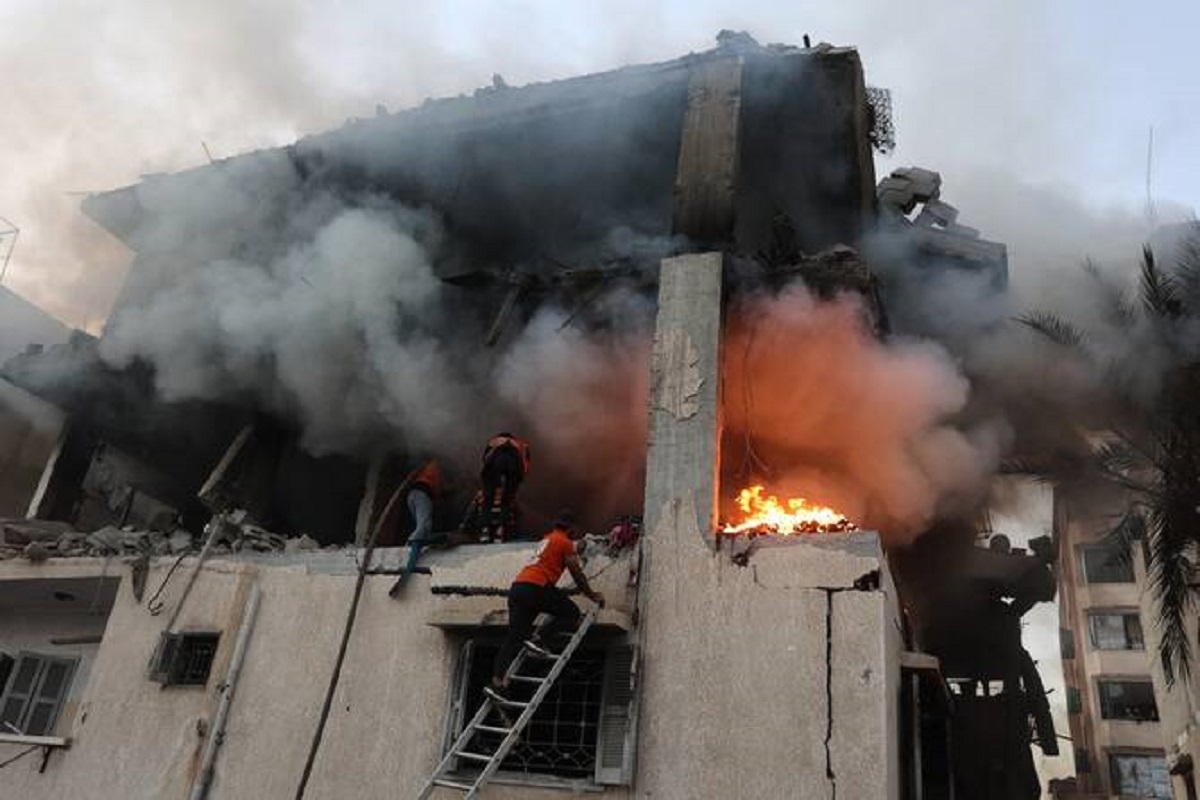
UN Security Council Resolution 2803 is destined to fail. That failure will come at a price: more Palestinian deaths, extensive destruction and the expansion of Israeli violence to the West Bank and elsewhere in the Middle East.
The resolution, passed last week, was a consolation prize for Israel after it failed to achieve its ultimate objective from the two-year Gaza genocide: the ethnic cleansing of the population and its complete takeover of the Strip.
Gaza shattered a core Israeli doctrine: the absolute certainty of its military supremacy’s ability to subdue the Palestinian people using far superior US and Western-supplied technology. Though the occupation was never expected to be easy — as Israel’s history of violence in the Strip attests — the complete takeover was, in the minds of the Israeli leadership, a foregone conclusion. In August, Israeli Prime Minister Benjamin Netanyahu stated with total confidence that Israel aimed to “take control of all of Gaza.” That proved to be wishful thinking.
How Israel has failed to subdue an impoverished and besieged population of 2 million people, subjected to a blockade, famine and one of the world’s most horrific genocides, is a question for future historians. The immediate consequence, however, is political: Israel and its Western backers, especially the US, understand that an utter Israeli failure in Gaza would be interpreted by Israel’s victims as a pivotal sign of the times.
An utter Israeli failure in Gaza would be interpreted by Israel’s victims as a pivotal sign of the times
In fact, the notion of Israel’s implosion and the end of the Zionist project has moved from the margins of intellectual conversation into the center. These ideas are bolstered by Israelis themselves and are a recurring topic in the Israeli media. A headline in Haaretz on Nov. 15 was hardly shocking: “At a secret Harvard site, a massive archive of Israeliana is preserved — in case Israel ceases to exist.”
Thus, US President Donald Trump’s “Comprehensive Plan to End the Gaza Conflict,” signed in Sharm El-Sheikh last month, was the official start of the American scheme to save Israel from its own blunders. The supposed ceasefire was meant to give Israel the chance to maneuver. Instead of occupying all of Gaza and pushing the Palestinians out, Israel would now use social and political engineering to achieve the same goal.
The first phase of the plan, which placed most of Gaza under Israeli military control in anticipation of a gradual withdrawal, is already proving to be a sham. At the time of writing, Israel, according to the Gaza government’s media office, had violated the agreement nearly 400 times, killing more than 300 Palestinians. Israel also continues to systematically demolish Palestinian areas.
Worse still, according to Gaza authorities, Israel has been expanding the share of Gaza it controls, estimated at about 58 percent, by moving the so-called Yellow Line westward.
The “ceasefire” has effectively enforced a new mechanism that allows Israel to carry out a one-sided war — with further territorial expansion, destruction, assassinations and occasional massacres — while Palestinians expect nothing but the mere slowing of the Israeli death machine. This is not sustainable, especially since Israel has also violated the most basic principle of the imaginary ceasefire: allowing vital aid to enter Gaza.
The UNSC resolution fully serves Israel’s interests, hence Netanyahu’s enthusiasm, yet Tel Aviv is still refusing to respect it
UNSC Resolution 2803 endorses the Trump peace plan without placing any legally binding expectations on Israel. It establishes a transitional administration that entirely excludes Palestinians, including the Western-supported Palestinian Authority.
The executive branch of this administration would be the International Stabilization Force, whose sole job is to “stabilize the security environment in Gaza” on behalf of Israel, notably by disarming Palestinian groups. The force, according to the resolution, will operate “in close consultation and cooperation” with Israel, meaning the force will be tasked with achieving Tel Aviv’s military objectives, thereby allowing Israel to determine the timing and nature of its own supposed gradual withdrawal.
Since Palestinians refuse to disarm — as unconditional disarmament without meaningful international guarantees would surely lead to the full return of the Israeli genocide — Israel will certainly refuse to leave Gaza. Netanyahu made that clear last week, when he stated that Israel would not withdraw without disarming Hamas, “either the easy way or the hard way.”
The partition of Gaza is a US-led attempt to change the nature of the challenge for Tel Aviv, while ultimately aiming to achieve the same objectives. The UNSC resolution fully serves Israel’s interests, hence Netanyahu’s enthusiasm, yet Tel Aviv is still refusing to respect it, making it clear there will be no phase two of Trump’s original plan.
The entire political scheme, however, is doomed to fail. Though Palestinian suffering will certainly worsen in the coming months, the US-Israeli gambit is fundamentally flawed: it is built on trickery and coercion, resting on the false assumption that Palestinians, fearing genocide, will accept any plan imposed on them. This premise ignores history. Palestinians have consistently defeated the sophisticated mechanisms designed to break them, meaning this new arrangement is equally unsustainable.
Ultimately, the failure of UNSC Resolution 2803 confirms one enduring truth: the Israeli war on Gaza has not stopped. It has simply changed form. It is crucial that people around the world understand this next phase for what it is: a diplomatic maneuver designed to facilitate the ongoing Israeli plan to control the Gaza Strip and ethnically cleanse its population.
Dr. Ramzy Baroud is a journalist, author and the editor of The Palestine Chronicle. His latest book, “Before the Flood,” will be published by Seven Stories Press.
This article was originally published on Arab News.
Views in this article are author’s own and do not necessarily reflect CGS policy.